
Prediction Markets, Sportsbooks Up Ante In Fight Ahead Of March Madness

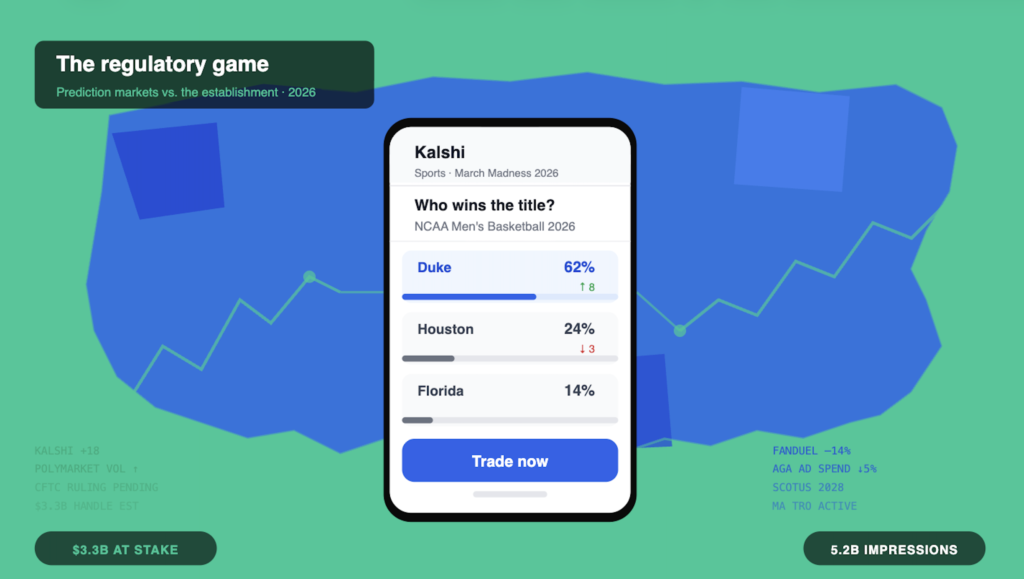
NEW YORK – With the NCAA Men’s and Women’s March Madness expected to generate $3.3 billion in legal betting revenue and Selection Sunday at hand, the ongoing fight between legacy betting operators, sportsbooks and regulators against prediction markets this week intensified outside the courtroom.
Polymarket appears on the verge of making its long-awaited full-throated push into the U.S. market. That move could come as soon as this weekend. The Commodities Futures Trading Corporation (CFTC) Thursday issued its long-awaited guidance for prediction markets, including recommendations on hoe they should handle sports-related contracts. And the American Gaming Association Friday used its annual estimation of the NCAA men’s and women’s March Madness legal betting handle to further jab at prediction markets.
The fight between legacy gaming operators and prediction markets spread across multiple stages at this week’s Next.io Summit. Kalshi and Polymarket stayed away. But speakers seemingly uttered their names in every other sentence.
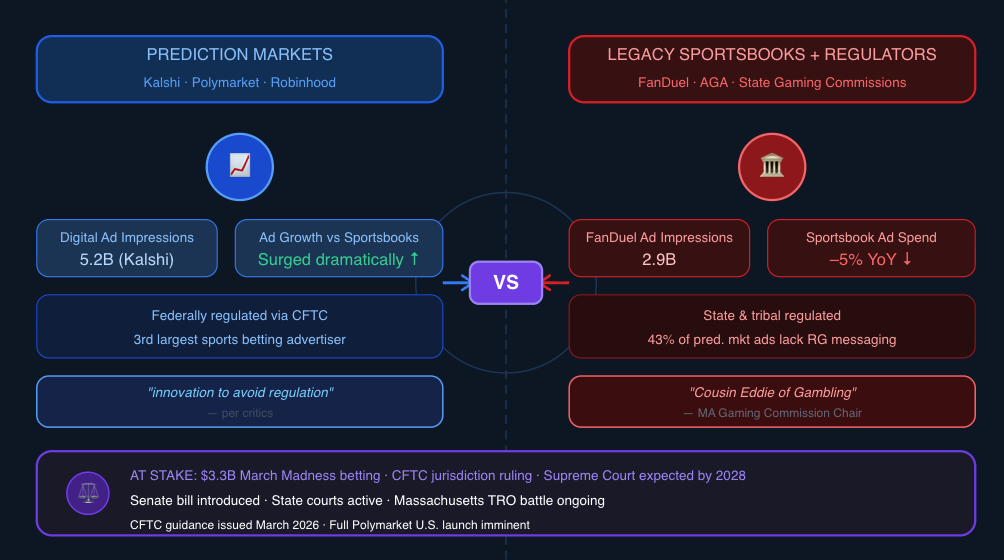
Massachusetts Gaming Commission Chair Jordan Maynard dubbed prediction markets the “Cousin Eddie of Gambling” at this week's Next.io Summit. The moniker pays in homage to the eccentric character played by Randy Quaid in the Vacation movies. Shawn Fluharty, a legislator from West Virginia and Head of Government Affairs at Play’n Go, didn’t hold back, either.
"They cloak themselves in innovation to avoid regulation,” Fluharty said of prediction markets and other so-called “disruptors.” He further referred to them as “bad actors” and warns that whatever gains they make under the Trump administration and current CFTC leadership could well disappear in a future administration.
"What happens when a new administration comes in? In one day, everything could change. It could go back to the states. Don't you think regulators will be a little angry?" he warned.

DraftKings Sports Welcome Offer Ts and Cs: GAMBLING PROBLEM? CALL 1-800-GAMBLER or 1-800-MY-RESET, (800) 327-5050 or visit gamblinghelplinema.org (MA) Please Gamble Responsibly. 888-789-7777/visit ccpg.org (CT), or visit www.mdgamblinghelp.org (MD), 1-800-981-0023 (PR). 21+ and present in most states. (18+ DC/NH/PR/WY). Void in CAN. Eligibility restrictions apply. On behalf of Boot Hill Casino (KS). Pass-thru of per wager tax may apply in IL. 1 per new DraftKings customer. $5+ first-time bet req. Max. $200 issued as non-withdrawable Bonus Bets. Stake removed from payout. Reward issued as $50 in Bonus Bets every 7 days via click-to-claim for 21 days. Bonus Bets and click-to-claims expire 7 days (168hrs) after issuance. Terms: sportsbook.draftkings.com/promos. Ends 9/20/26 at 11:59 PM ET. Sponsored by DK.
Digital Ads Surge From Prediction Markets, Study Says
Citing data from Sensor Tower, the AGA Friday said that prediction market platforms have rapidly increased their advertising presence. While digital ad impressions for online sportsbooks fell nearly 14% in 2025, impressions tied to prediction market advertising “surged dramatically.”
Nearly one in five (15%) digital "sports betting ads" seen by consumers last year did not comply with state-mandated responsible gaming messages, the AGA said.
Kalshi alone became the third largest sports betting advertiser by digital impressions in 2025, according to the AGA’s numbers. Kalshi had no comment on the AGA’s findings Friday.
Prediction markets such as Kalshi and Robinhood are federally regulated exchanges governed by the CFTC. The question of whether the sports-event contracts they offer equate to sports betting continues to rage in multiple state and federal courtrooms across the nation.
Two Democratic Senators - Richard Blumenthal of Connecticut and Andy Kim of New Jersey - Wednesday introduced a bill that would ban prediction market insider trading, restrict users under 21 and make ensure state oversight.
The consensus among nearly a dozen speakers surveyed by Bookies.com at Next.io sees that decision made by the Supreme Court before the end of 2028. Bookies.com first reported on inevitable outcome a year ago.

Promo Code: BDC
Underdog Prediction Welcome Offer Ts and Cs: No Purchase necessary. ; new users must make a first-time deposit. Milly Bucks have no cash value. Bonus entries are not cash, must be played through 1x within the turnover period (14 days unless otherwise stated), can't be used on prediction picks or entries paying under 2x, and are forfeited if unused. All 20 questions must be completed within 60 days. 18+ (19+ AL, NE; 21+ AZ, MA, VA). Must be physically present in an eligible state. Void where prohibited. Gambling problem? Call 1-800-GAMBLER.
Breaking Down Increase In Prediction Market Ads
A bill in Massachusetts proposed by Sen. John F. Keenan, known as the Bettor Health Act would, among other things, ban sports betting ads during game telecasts, in-play wagering, and prop bets. Those bans would not apply to prediction markets ads or trades in the current bill. However, they could well be added in committee or during floor debate. Currently, the Commonwealth and Kalshi battle in court over the implementation of a temporary restraining order.
The AGA claims 43% of digital sports betting ads seen by U.S. consumers did not comply with state gaming regulations requiring responsible gaming messaging since they came from prediction market operators. It added that Kalshi is the most visible "sports betting brand" by digital ad impressions, with consumers exposed to its advertising approximately 5.2 billion times this year, compared with 2.9 billion impressions for FanDuel, the next most frequent sportsbook advertiser.

theScore Bet Sportsbook Welcome Offer Ts and Cs: Must be 21+ and present in AZ, CO, IA, IL, IN, KS, KY, LA, MA, MD, NC, OH, TN, or VA. Gambling Problem? Call 1-800-GAMBLER (CO, IL, KS, KY, LA, MD, NC, OH, VA). Call 1-800-NEXT-STEP (AZ). Call 1-800-BETS-OFF (IA). Call 1-800-9-WITH-IT (IN), Call (800)-327-5050 or gamblinghelplinema.org in MA. Call or text REDLINE: 800-889-9789 (TN).
State- and Tribal Operated Sports Betting Advertising Declining
A Nielsen study commissioned by the AGA shows that despite increased betting activity, overall sportsbook advertising volume has continued its multi-year decline.
- Sports betting ad spend fell 5% year-over-year.
- Sports betting ad volume across all channels declined 1% year-over-year and is 27% lower than the 2021 peak.
- Sports Betting TV ad volume declined 9% and has decreased 50% since 2021
The data show sports betting advertising represents just a small portion of U.S. television advertising.
- In 2025, sports betting accounted for just 0.9% of TV advertising spend, compared with 1.5 percent for alcohol advertising.
- 39 pharmaceutical advertisements aired for every sports-betting ad in 2025.
“Confidence in your wager - and in the integrity of the games - starts with a fair and compliant betting market,” said Miller in an AGA release. “That’s why it’s so important that everyone offering sports bets in the U.S. comply with state and tribal regulations, ensuring that consumers are protected.”

Bet365 Sports Welcome Offer Ts and Cs: GAMBLING PROBLEM? CALL 1-800-GAMBLER or 1-800-MY-RESET (AZ, CO, IL, IN, KS, KY, LA, MD, MI, MO, NC, NJ, OH, PA, TN, VA) or 1-800-BETS OFF (IA). Call 1-800-NEXT-STEP (AZ). Call 1-800-9-WITH-IT (IN). CALL 1-877-770-STOP (LA). 21+ only. Please gamble responsibly. Must be present in AZ/CO/IA/IL/IN/KS/KY/LA (select parishes)/MD/MI/MO/NC/NJ/OH/PA/TN/VA. Licensee partner Amelia Belle Casino. Minimum $10 deposit required. Minimum odds -500 or greater. Bonus Bets wager excluded from returns. New customers only. T&Cs, time limits and exclusions apply.
About the Author
 McLuck Free To Play Welcome Bonus; get 60 SC free! September 2026
  Polymarket Promo Code BOOKIES: Deposit $10, Get a $50 Trading Bonus
  Best Megaways Slot Games September 2026
  Novig Promo Code BOOKIES: Get a $25 Purchase Match Bonus
  Best NFL DFS Sites & Apps For Week 2 September 2026
  Fanatics NFL Promo Code BOOKIES: Get $1,000 in Matched FanCash
Comments