
Where Do Betting Lines Come From? A Look From Las Vegas And Beyond

Inside the models, power ratings, sharp bets and human judgment that create the numbers now attached to nearly every moment in sports
LAS VEGAS – For millions of Americans, the line supersedes the score. Winning or losing is solely determined by whether their team of choice covers the spread, not figures posted on a scoreboard. The betting line looms as a mysterious and often misunderstood number ubiquitous with every NFL and nearly every college football game.
The betting line sits beneath matchups on television, scrolls across studio shows, pops up in sponsored spots in the middle of a game, and appears beside injury reports and starting lineups on a phone. It changes during commercial breaks, after touchdowns, or the next snap. A fan can watch on one screen, follow live odds on a second and bet on a third. Or, do it all in one spot, depending on the app.
Before mobile betting, the line lived in a newspaper’s agate type, passed from Las Vegas by phone, printer or fax.
Fans called it “the Vegas line,” as though it came fully formed from one desert room.
In 2026, the betting line permeates the gridiron from Thursday Night Football through Wednesday MACtion.
Where do betting lines come from?
Over the past 11 months, that question was put to bookmakers, oddsmakers, sportsbook owners, professional bettors, historians, prediction-market traders and Kalshi's CEO.
Their answers differed in detail and sometimes in philosophy. Together, they described a number that starts as an informed opinion, becomes a tradable price and is tested repeatedly by people willing to risk money to prove it wrong.
The short answer is data, mathematics, information, opinion and money. The full answer runs from the bookmaker’s first estimate through the market’s verdict—and back through nearly a century of history.
This is the life of a betting line.
The NFL Is King -- Long Live the King
The NFL season began Wednesday night with a Super Bowl rematch between the champion Seattle Seahawks and runner-up New England Patriots.
The line on that game dropped within seconds of the NFL making the date official this past May.
Off-shore sportsbooks in Central America and the Caribbean, their legal U.S./Canadian counterparts like DraftKings and FanDuel, and the open markets on prediction platforms immediately installed the Seahawks as betting favorites.
The initial public line had the Seahawks as 4.5-point favorites. Pro bettors, known as “sharps” because they are the best ones to normalize or flatten a line, here and elsewhere initially bet Seattle up to 6 points. After all, the Seahawks smothered New England 29-13 in an all-time snoozer last February. That trend soon reversed, in part because the Patriots landed A.J. Brown.
Retail and sharp money moved toward New England.
The line eventually shrunk to Seattle -3.5 points in July.
It remained there until kickoff.
Final score: Seattle 13, New England 10.
"Damn, these guys are good."
Up to $35 Billion On The Line This Season
Estimates on the projected betting handle at legal U.S. sportsbooks for this upcoming NFL season range from $29.5 billion to $32.3 billion to $35 billion.
NFL-based trades on U.S. prediction markets are pegged to hit $36.8 billion this season.
Sports betting handles and prediction market trading volume are not calculated in the same manner. On a prediction market, traders can move in and out of the same position on any given game. Thus, those numbers tend to skew significantly higher when compared to the mostly static action at traditional sports books.
This enormous business turns on a deceptively small set of numbers: 3.5 points, 47.5 total points, -110, +240, 276.5 passing yards. And millions of combinations thereof.
‘The Gambler’ vs. ‘The Bookie’: A Cat-and-Mouse Game
Where Do Betting Lines Come From?
How data, bookmakers and bettors turn an estimate into the closing line. Illustrated with one fictional NFL matchup, Team A vs. Team B.
Build the raw number
The opening line
The opener is an informed estimate — not a prediction.
Bettors test the number
- Bet earlier
- Target weak prices
- Their identity matters
- Can move the line with less money
- Usually bet later
- Favor popular teams and overs
- Provide much of the volume
"It's a cat-and-mouse game. The bettor wants a better price. The bookmaker doesn't want to give it to them."
The line moves
A book can move the price before it moves the point spread. Reason tags above show what triggers each shift; competing sportsbook moves count too, even without new public information.
The sportsbook manages risk
The sportsbook is managing price, information and liability — not necessarily seeking 50-50 action.
The closing line
The closing line is the market's best collective estimate before the game begins. It is not a prediction of the final score.
Different structure. Same challenge: finding the right price.
Betting And Football Have Come A Long Way, Baby
The transformation of the pro and college football betting space dwarfs the changes that the game itself has undergone since the turn of the century. "Gambling” was effectively a four-letter word across NFL-controlled media. The Shield long banned any mention of “Las Vegas” from its game telecasts.
Brent Musburger and “Jimmy The Greek” used to refer to their “Friends in the Desert” when picking games on “The NFL Today” in the age of low-def TV. Al Michaels has never been subtle when noting the importance of a late-game touchdown in a blowout.
This season, the NFL has official sports-betting sponsorship, data, and integrity deals with DraftKings, FanDuel and Fanatics. Sin City played host to Super Bowl 58 and will do so again for Super Bowl 63.
Billy Walters, author of The Gambler, spent a lifetime trying to beat the line. The ascendancy of prediction markets such as Kalshi and Polymarket transformed what was once the domain of real-life characters like Frank “Lefty” Rosenthal, Mike “Roxy” Roxborough, and Bob “Blackie” Black to a world where anyone can set a line. At least in theory.
Asked what the rise of exchange-style prediction markets might have meant at the height of his power, the legendary bettor supplied an answer that sounded like a boast, a joke and a warning all at once.
“If prediction markets existed 25 years ago, then I’d be worth a hundred billion dollars,” Walters said during a rare public appearance at BetBash.
Walters’ point was not that the games would have become easier to predict. It was that more marketplaces, more liquidity and more ways to take the other side would have allowed a bettor with an edge to put far more money behind it. The line is information, but access to the line—and the ability to attack it before it changes—is the business.
On the other side of the real and digital betting window sit operators like Art Manteris. Author of The Bookie - Inside the High-Stakes World of Sports Betting, Manteris spent 40 years operating some of the biggest sports books here, including Caesars Palace and the Superbook at Westgate (formerly the Las Vegas Hilton).
In setting and moving line, Manteris' mission was to make sure the book landed on the right side of each outcome, while making sure the rules were followed by all involved. The business is built not on supernatural predictions but on price, volume and margin.

The First Number
Start with an NFL point spread.
Before a sportsbook can decide whether Philadelphia should be favored by 3 or 3.5 points, it needs a numerical opinion of both teams. Oddsmakers and serious bettors traditionally begin with power ratings: a ranking expressed in points that estimates the strength of every team on a neutral field.
If Team A is rated four points better than Team B, the raw spread is four. Then the work begins.
Home field must be added, but the old three-point assumption has weakened and never applied equally. Injuries—especially at quarterback—weather, travel, rest, turf, coaching tendencies and specific matchups can alter the estimate.
DraftKings and FanDuel control roughly 70% of the legal U.S. sports betting market. Sports betting is legal in 39 states, Washington D.C., and Puerto Rico. Neither FanDuel nor DraftKings are licensed to offer sports betting or sports-based prediction trades in Nevada.
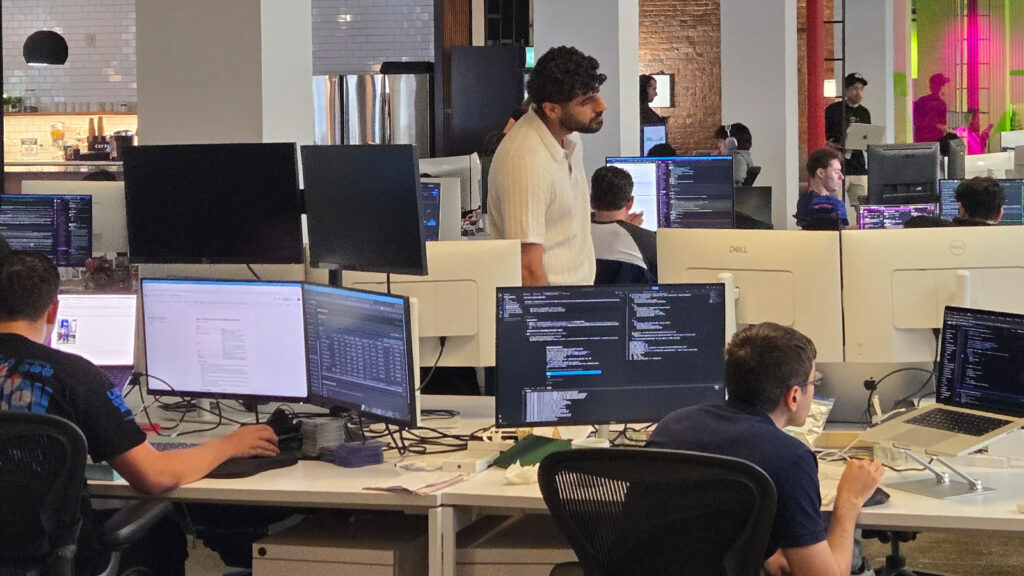
The DraftKings four-story, 90,000-square-foot office space in Las Vegas lies inconspicuously five miles southwest of the famous Strip. Without the signage, one could easily see another multi-use office space. And not the nerve-center of a $6.5 billion betting operation. The Durango Casino and an IKEA sit across the street.
The view from FanDuel’s office at the bottom of Madison Avenue in Lower Manhattan spans from Brooklyn and Queens, to the Freedom Tower, to New Jersey. But the work at both sites remains the same. Settling numbers, moving lines, monitoring the money, keeping another eye on questionable plays and random line movements.
Director of Sports Operations Johnny Avello spent parts of 4 decades setting odds on the Las Vegas strip before joining DraftKings. He said the company uses sport-specific groups within a global trading operation of roughly 100 people. Their opening lines grow from proprietary models fed with data, then are reviewed by humans.
“Those lines are based on the data that we feed our model,” Avello said. “That’s where we get our original lines from.”
The model does not get the last word. If it makes Philadelphia a 14-point favorite over the New York Giants, Avello said, a trader may look at the result and decide the practical number should be 12.
“We kind of still use our minds besides the data that’s fed to the model,” he said.
A FanDuel football trader described a similar marriage of computation and judgment. The company develops its core NFL and college football lines and player props in-house, using internal pricing tools, outside data and trader projections. Around 20 traders across the United States, Canada, United Kingdom and Australia work on the NFL daily, while more than 40 touch the league during a season.
One Number Creates Dozens More - And Then Some
For sides and totals, the process combines a modeled projection with market ratings and the trader’s feel for what the available information means. Player props are built from the top down. FanDuel first estimates how many plays a game will contain, then distributes those plays through expected run and pass rates, targets, carries, completions, yards and other outcomes until the model reaches an individual projection.
That is why one number begets dozens of others. A spread and total imply a projected score. The score implies game script. Game script affects how often each team is likely to pass or run. Those estimates flow into a quarterback’s attempts and passing yards, a running back’s carries and a receiver’s targets. A change to the game total can ripple across an entire prop menu.
That blend is the modern version of an old process. A computer can process thousands of inputs. It cannot always recognize that a defensible number is commercially unrealistic or that a coach will change tactics without an injured lineman.
Joey Feazel, head of football at Caesars Sportsbook, described the same starting point with a broader list of inputs: years of historical data, advanced statistical models, power ratings and football expertise. Caesars evaluates coaching, injuries, roster strength, pace of play, home-field advantage, travel and dozens of other variables before publishing an opening market.
Caesars’ football trading and risk teams operate in Las Vegas, west of The Strip. During the season, Feazel said, football becomes an all-hands-on-deck product, with everyone on the trading floor involved at some point.
NFL Betting Lines Have Their Roots In Power Ratings
Walters’ system begins with team power ratings, but it does not end there. He separately values quarterbacks and other important players so an injury can be translated into points. He accounts for home field, weather, travel, stadium quirks, turf, schedule spots and emotional circumstances.
Walters’ approach illustrates why a line is not simply a prediction. A quarterback might be worth roughly a touchdown compared with his backup; an elite non-quarterback may be worth 2.5 or 3 points; most players may be worth effectively zero to the spread. Cluster injuries can matter more than the sum of their parts. Walters classifies special, weather and emotional factors and updates their historical effects. The purpose is to attach a value to circumstances before the bookmaker—or the market—does.
FanDuel starts in the same place but expresses it through modern metrics. Individual statistics, Pro Football Focus grades and expected points added per play help assign values to players. Then team-level measures such as yards per play, yards per play allowed and point differential test whether the win-loss record is telling the truth. A 5-0 team with a point differential of only plus-10 may be winning close games at a rate that is unlikely to continue. The rating should measure the team’s underlying strength, not merely reward the standings.
Power ratings therefore are not a weekly ranking column. They are a working ledger. Every injury, schematic change and new performance adds evidence. The bookmaker translates that evidence into points, then asks whether the model has missed something obvious to a coach, bettor or trader.
At Caesars, roster strength and coaching are the two main elements in the power ratings. Quarterbacks and skill-position players produce the largest individual adjustments, Feazel said, although the value of other position groups can become significant depending on the matchup and the depth behind an injured starter.
A similar approach can be found on the East Coast.
“You start with your power ratings, which is going to give you what a spread should be on a neutral field," said Thomas Gable, Director of Race and Sports at the Borgata Atlantic City. "Then you're going to factor a home field advantage, injuries and weather. Quarterbacks are worth more to the number than any of the other positions. It's really the difference. If a starter goes out and a backup is starting in their place, what is the difference in value between the starter and the backup."
Pro Football 'Least Complicated' Market
Roxborough, the influential oddsmaker who founded Las Vegas Sports Consultants, calls pro football “the least complicated” football market because the universe is contained: 32 NFL teams, compared with 138 in the Football Bowl Subdivision and roughly another 130 in the Football Championship Subdivision. His firm wanted bookmakers to restrict the college schedule. They refused.
“They think more games, more money,” Roxborough said. “But some of these games are so obscure only the sharp players bet them.”
More teams mean more players, injuries, coaching changes and mismatches to evaluate—and more places for a specialist to know something the bookmaker does not. The growth of data helps, but it has not eliminated football judgment. Roxborough still watches yards per point and cluster injuries. Losing two players on the left side of an offensive line can matter more than losing one All-Pro because the replacements must operate together and the opponent can repeatedly attack the weakened area.
That leads to what Walters calls the central truth of betting: value. A bettor’s prediction must be better than the bookmaker’s, and the bettor must get the right number at the right price.

Opening Line Just A Starting Point
The first publicly available number is called the opening line. It is important, but it is not sacred.
DraftKings posts all 272 NFL regular-season games soon after the schedule is released. As the season approaches, the book updates power ratings, injuries and expectations. During the season, it offers look-ahead lines for the following week, then strengthens the markets after Sunday’s results.
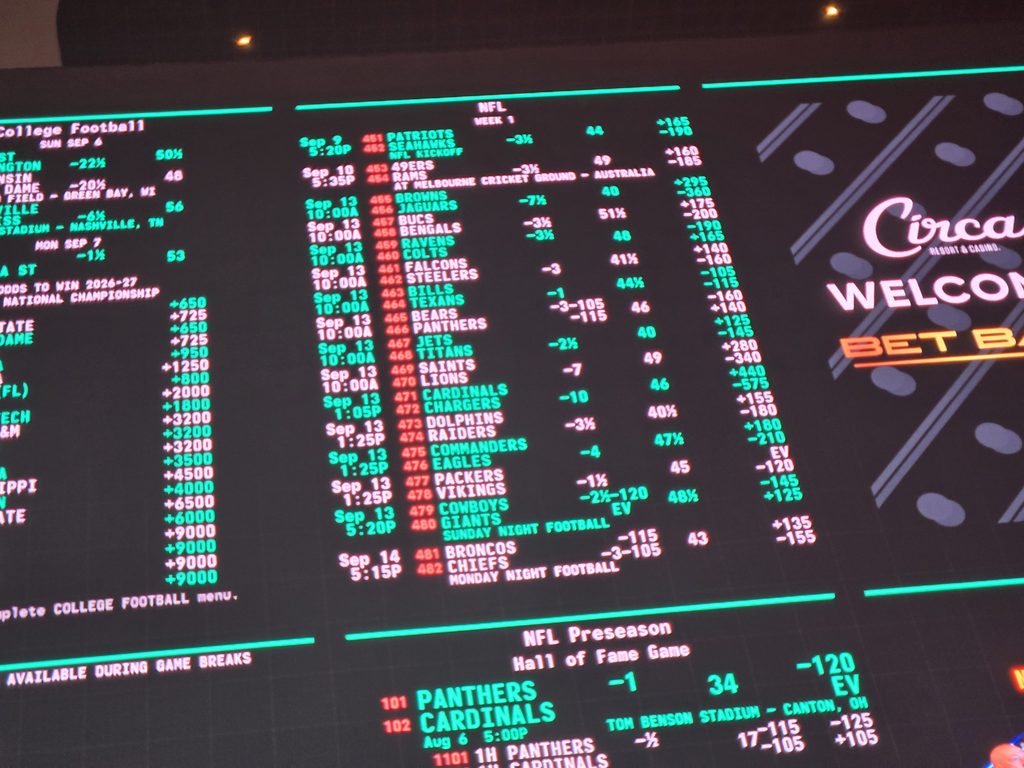
Circa’s College Football Sunday Opener
Vegas Vicky keeps one LED-powered neon eye on the palatial sportsbook at the Circa. The book’s 4,484-square-foot, 3-story tall TV wall emits 78 million pixels worth of televised action and betting lines. Every Sunday morning, Vegas Vicky watches, never bothering to blink, as bettors line up to get the first crack at next week’s college football lines. (Her betrothed, Vegas Vic, stands watch over Fremont Street, with the same cigarette dangling from his lips for decades.)
Bettors get one turn, then return to the back of the line.
Circa Sports owner Derek Stevens says the ritual is really a rapid experiment in price discovery.
“We let everybody get a bite at the apple,” Stevens said. Within 30 minutes to an hour, Circa believes the early bets have helped establish a credible baseline. The numbers then go online, where a much larger market continues to “massage” them.
NFL Lines Take A Different Path
The NFL is different. With fewer games and more information, nearly every major book can calculate all 272 matchups within a day. In Stevens’ view, that produces an immediate consensus rather than one unquestioned originator.
John Murray, executive director of the Westgate SuperBook, said his team reviews its advance line, the bets already taken and everything that occurred on game day. A poor performance or injury may require a tweak. Then the number goes up.
“Once the line is up for betting, you can let the sharp guys guide you to the right number,” Murray said.
That is the essential point: an opening line is both an opinion and an invitation to challenge it. The SuperBook was purchased by Caesars earlier this year, with Murray remaining as manager.
Adam Bjorn, CEO at Plannatech/Betcris AZ, a longtime gaming executive, is even less sentimental about the opener. In the modern NFL market, he said, origination does not matter as it once did. An early Week 1 number posted months before kickoff can feel less like a masterpiece of oddsmaking than “someone just throwing up darts and then letting the money do the talking.”
That does not mean the opener is careless. It means uncertainty is unusually high, the limits are initially controlled, and the book knows the number will be stress-tested.
Bjorn used that Patriots-Seahawks market to show how the public’s view of one smooth move can hide a much messier path. A line can travel from 4.5 to 6, then be hit back through 5.5, 4.5, 4 and 3 before settling at 3.5. Professional bettors are not merely predicting the winner. They are buying particular prices along the route, especially around key numbers.
“You put up a number and then price discovery begins,” Bjorn said. “The better players you have in, and the fairer limits, you find that price discovery a lot quicker, and then you can just open up your limits to the recreational.”
The Limit Is Part of the Line
The limit is part of the line. A retail book may be willing to take $2,000 at an uncertain opener, $20,000 after respected customers have tested it and far more once the market is mature. The posted spread can be identical in all three moments, but the book’s confidence—and the bettor’s ability to capitalize—has changed.
Online books have different limits - high and low - for different players. Some bettors find themselves limited to wagers less than $3. VIPs can place wagers up to $1 million and beyond, depending on the bettor and event.
This is one reason closing-line value has become a shorthand for betting skill. A bettor who repeatedly wagers at +4 on games that close +3 is acquiring a better price than the market ultimately offered. That does not guarantee any single bet will win. Over a meaningful sample, however, consistently beating the closing price is evidence that the bettor is seeing value before consensus catches up.
Prediction markets, conversely, do not place any set limit on the amount of money someone can trade on an NFL game. The amount, and the line, are determined by finding someone else to take the other side of the same trade. So-called "market makers" exist to help facilitate this.
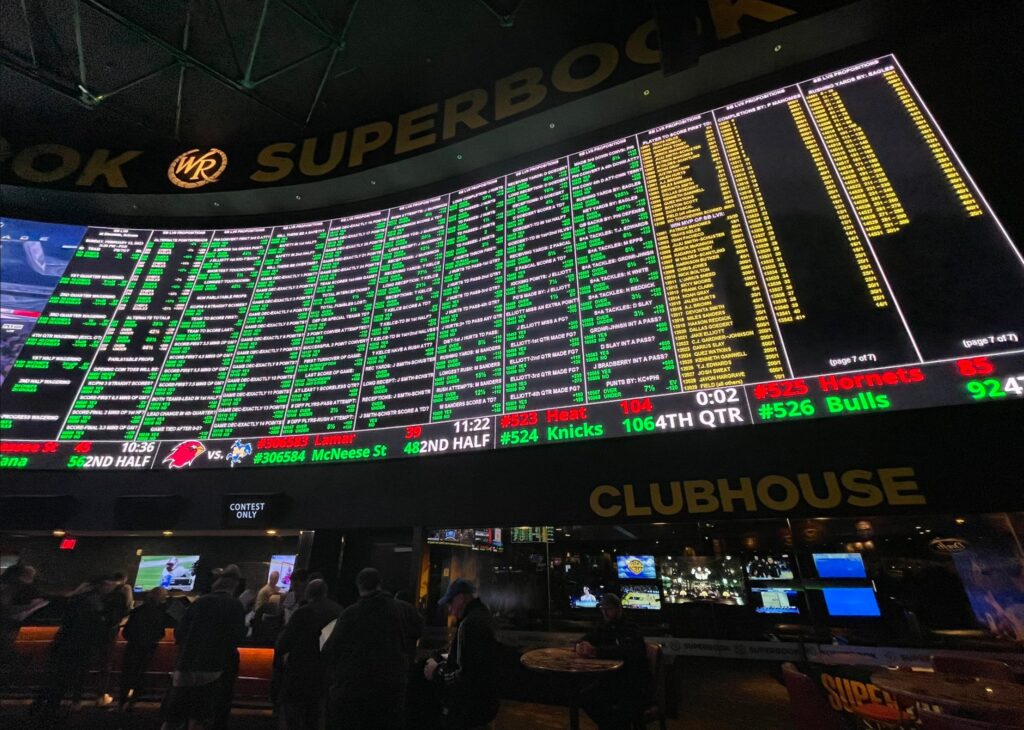
What Makes the Line Move?
A betting line moves for two broad reasons: the underlying facts changed, or wagering revealed that the price was wrong.
Information Moves and Market Moves
The first category is easy to see: A quarterback is ruled out, heavy wind enters the forecast or a coach says starters will rest. The sportsbook moves because the probability changed.
Feazel said Caesars responds as new information arrives each day. Injuries and major weather changes can cause the most dramatic moves, but wagers from sophisticated bettors also influence the price.
“Our goal is to have every one of our lines reflect the probability and odds we are offering to the customer by kickoff, or even sooner,” Feazel said.
The second category is more complicated. Books do not treat every dollar equally.
Stevens described movement as a blend of money and respected players. A “tidal wave” of wagers can force an adjustment. So can one smaller bet from a customer with a documented ability to beat opening numbers.
For Murray, respected play is the leading factor. But books distinguish between a bettor who originates a winning opinion and one who merely races to grab a stale number. Both may prompt a move, but only one supplies new information.
Chris Andrews, the longtime oddsmaker who runs the South Point sportsbook, put it bluntly. A six-figure wager from one customer may mean less than a $10,000 bet connected to Walters.
“If I find out it’s Billy’s guy and he bet me 10,000, let’s say, well, I’m going to move the [heck] out of that number,” Andrews said.
The wager is information; the customer’s identity gives it weight.
Andrews, speaking in a Pittsburgh Steelers shrine that doubles as his office adjacent to the South Point book, said the art begins after the opener. He makes his own pro and college football numbers, but he also knows that straying too far from influential books such as Pinnacle and Betcris can invite arbitrage.
The initial number matters.
What matters more is the decision that follows every bet:
- Is this customer expressing an original opinion?
- Is the customer grabbing a move that already happened elsewhere?
- Does the customer know about an injury? Are they betting for someone else?
- Should the book move a half-point, adjust only the price, lower the limit or take another wager?
Manteris and Andrews are Greek-American first cousins who grew up in Pittsburgh. They learned their trade under tutelage of their uncle, “Pittsburgh” Jack Franzi.
As far as the real, imagined and often-glamorized ties between gambling and those of Greek heritage, Andrews says “there must be something in the culture.”
Who Makes the Bet Matters More Than How Much Is Bet
The best bookmakers build a mental and digital dossier on the answer. A recreational customer betting $100,000 on a popular favorite may create liability without adding much information. A $10,000 wager from a known winning syndicate may tell the book its price is about to disappear everywhere.
Sportsbooks also watch one another. A book that leaves Chiefs -2.5 available while respected shops move to -3 will attract bettors and automated systems taking the stale price. Real-time odds screens make changes visible almost instantly. Major NFL spreads therefore cluster within a half-point, with differences often expressed through price -3 at -120 instead of -110.
Books are cautious around key football numbers, especially 3 and 7. Moving from -2.5 to -3.5 crosses the NFL’s most important margin. A book may raise the price on -3 before crossing it.
This is also why line histories can look like staircases rather than straight paths. At -3, a sportsbook might move from -110 to -115, then -120 and -125 before deciding whether the market justifies -3.5. Bettors who disagree may take the underdog at +3.5, pushing the book back toward 3. The spread, price and limit are three different controls applied to the same risk.
Movement creates risk. If a book takes favorite money at -2.5 and underdog money at +3.5, a three-point margin can pay both groups. That “middle” is wonderful for bettors and painful for the house.
Head Fakes and Market Copying
Sophisticated bettors have also long used “head fakes”: betting one side at enough influential locations to encourage a move, then wagering much more on the other side at the improved number. Manteris said he watched a player demonstrate a modern version online. Small bets on two college basketball games moved the price, books across the market copied the change, and the bettor came back larger in the opposite direction.
Technology made copying faster. It did not remove manipulation.
The Myth of Perfect Balance
The familiar explanation says bookmakers want equal money on both teams and collect the commission no matter who wins. It is a clean teaching device. It is not a literal description of every book or every game.
“We’re never going to balance out 50-50,” Avello said. “That doesn’t happen. And that’s okay, because we really don’t want to.”
Murray adds: "A 50/50 balance is impossible because most of the money you make is from parlays and teasers anyway. It's not really about straight bets."
The sportsbook wants an accurate price, manageable liability and protection against customers with better information. It may be comfortable opposing casual money or move aggressively when sharp bettors reveal a bad opener, even if the ledger is not lopsided.
Roxborough reduces the negotiation to its enduring essence.
'It's A Cat-And-Mouse Game'
“It’s a cat-and-mouse game,” he said. “The bettor wants a better price. The bookmaker doesn’t want to give it to them.”
Who is the cat and who is the mouse?
“That depends on what side you’re on,” Roxborough said through a smile.
It also depends on the day of the week.
“The start of the week, the bookmaker's the mouse and the professionals are the cat. When the game comes, it's the bookmakers being the cat and the recreational bettor being the mouse,” Bjorn said. “Roxy's talking about an era that was more fun, but doesn't really exist as much anymore because of technology.”
The late public money often prefers favorites, overs and moneyline parlays. The book may welcome that predictable flow at a price the sharper portion of the market has already helped refine. It is not balancing every game so much as managing a portfolio of positions under limits, rules and margins designed to give the house a durable advantage.
Standard spread pricing of -110 means a bettor risks $11 to win $10. Win one and lose one, and the bettor is down $1 while the book retains it. A bettor must win 52.38% at that price just to break even.
That charge is the vig or juice. It is not the same as hold: Vig is embedded in the price; hold is what the sportsbook actually retains after results are settled.
Why Parlays Pay Off Big For The House
Parlays are lucrative for sportsbooks because every leg must win. That helps explain their prominence and the never-ending push for same-game parlays in ads and promotions. On prediction markets, they carry moniker of "combos."
The math is unforgiving. A standard two-team parlay of -110 sides commonly pays about 2.6-to-1 even though the true combined price, absent vig, would be 3-to-1. Add legs and every selection must still win, while the embedded house advantage compounds.
"Obviously the books have an incentive to push them," Gable said. "The reason parlays pay well is because they're tough to hit. And obviously that's why sports books try to push them, especially the online books."
Parlays can produce spectacular customer screenshots (above) and equally spectacular profits and handles - at times up to 60% depending on the sport - for both sportsbook and prediction market platforms.
Those flashy and endless TV ads don't pay for themselves.
From Sides and Totals to Everything
The same principles extend beyond the point spread.
A passing-yard prop begins with projected plays, pass rate, efficiency and the opponent’s defense. A total incorporates projected pace, efficiency, weather and game script. A moneyline converts estimated win probability into a price, then adds margin.
Caesars also generates its prop markets in-house. Historical performance is central to the pricing, Feazel said, with each season adding evidence that can be used to refine the next set of projections.
Once those markets are posted, words can matter as much as data. A coach saying a running back will be on a “pitch count” changes his rushing and receiving projections. A suspension, trade, benching or dramatic weather shift can force traders to recalculate the entire family of related markets. The adjustment does not stop at one prop. If the starting quarterback is scratched, the spread, total, moneyline, backup quarterback props, receiver props and perhaps even opposing defensive markets may all need to move or be suspended.
But not every market is equally efficient. A national NFL side can absorb enormous bets because information and liquidity are deep. A WNBA player prop or an awards market has fewer informed participants and greater informational risk. Sportsbooks protect themselves with wider prices and lower limits.
Super Bowl props show how creativity becomes a market. Mike Palm, Circa’s vice president of operations, said the book’s NFL traders begin assembling ideas during the playoffs. Staff and customers contribute suggestions. Each proposed bet must pass two tests: Is it interesting, and will it generate enough handle to justify the work required to price it?
How The Fridge Led The Way To Prop Madness
That process has roots in one of Las Vegas’ most famous bets. Before Super Bowl 20 in 1986, Manteris and his Caesars Palace team posted 20-1 odds that 335-pound Bears lineman William “The Refrigerator” Perry would score.
So much money flooded in on The Fridge, the number eventually closed at 2-1. Perry did score, ruining Walter Payton’s chance to score a Super Bowl touchdown. The score cost Caesars roughly $250,000 – about $760,000 today. Yet the publicity demonstrated that a sportsbook could sell far more than a side and total. The modern Super Bowl prop menu grew from that moment.
“We kept getting winning tickets on that bet for years,” said Vinny Magliulo, an oddsmaker for Caesars at the time.
That night, the marketing power of betting manifested itself. Manteris’ Refrigerator Perry taught him something valuable about publicity. A novel number could become a story, and the story could turn the sportsbook into part of the event itself. Contests, promotions, props and press releases were not decorations around bookmaking. They could produce customers.
The Line Never Stops Moving
Live betting expanded the concept again. Algorithms recalculate prices after every consequential event, but humans supervise. A model sees down, distance, score and time. A trader may see a limping quarterback or a coach departing from historical tendencies.
Bjorn estimates that for the NFL, the handle at a modern operation can be roughly divided between pregame and live betting. That turns one football game into hundreds or thousands of sequential pricing decisions. The opening spread may be debated for days; a live line may have seconds to live.
The integrity exposure rises with the menu. Manteris, who spent a decade consulting for the NBA, draws a line between conventional props and bets on hyper-granular events such as the next pitch or next shot. The easier an event is for one participant to control—and the smaller the natural betting pool—the greater the risk that unusual action is not just a smart opinion. The same technology that allows a book to offer more markets also requires faster monitoring of customers, accounts and betting patterns.
The Role Of Prediction Markets: A Line For Everyone
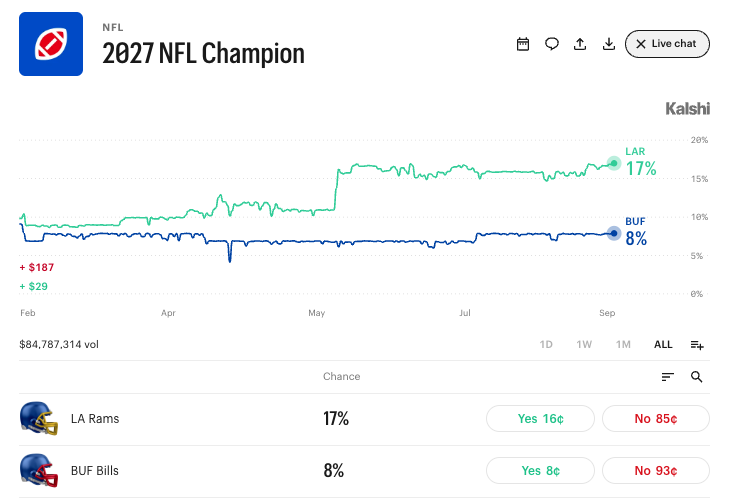
Prediction markets and betting exchanges change the structure, but they do not eliminate the need to create a price. Kalshi handled more than $900 million in Super Bowl 60-related trades, including both in-game and off-the-field outcomes (such as the half-time performers).
At a traditional sportsbook, the operator posts odds, accepts the wager and owns the resulting liability. On an exchange, users can post orders to buy or sell contracts, theoretically trading directly with one another. The price represents an implied probability: a contract trading at 60 cents suggests roughly a 60% chance before fees and market friction.
Sportsbook vs. Prediction Market
Two different ways to price the same outcome.
Liquidity Is the Product
An active exchange cannot depend on two casual users arriving with equal and opposite opinions. It needs liquidity—the ability to trade meaningful size at a reasonable price. That is the market maker’s job.
One Novig market maker who did not want his name used because of the proprietary nature of his work said his task is to keep liquidity available on both sides, decide how tight the price should be and determine how much size the market can safely support.
That sounds different from bookmaking—and legally and structurally it is—but the practical problem is familiar. The market maker must estimate fair value, protect against better-informed traders and update the price when orders reveal new information.
Peer-to-peer matching occurs, especially in major events. Yet our market maker estimated that most trades involve a sophisticated liquidity provider on one side. Prediction markets do not make oddsmakers disappear; they distribute the function among algorithms, market makers and the order book.
Hayden Ware, whose background was in options trading rather than bookmaking, said his financial-market background shaped an exchange-style product differently. Finance begins with bids, asks, liquidity and inventory. Sportsbooks begin with odds, wagers and house liability. As the two forms converge around sports, their vocabulary differs more than their daily pricing problem.
Kalshi Shocked The Betting World With Four Words In 2025
In January of 2025, Kalshi used four simple words to leap into football and sports betting/trading.
That sentence in a self-certification letter to federal regulators began a path that's led to $14 billion in combined NFL and college football trading since. Kalshi says its NFL-related trading volume is up 14x over last season at this time.
Kalshi CEO Tarek Mansour said the “wisdom of the crowd” can be just as important when determining the best number for a football game, as it can be in trying to determine the outcome of an election.
“The sportsbook sets the odds; they give you the odds what they think it should be. That is generally advantageous for the sportsbook, and you're not really a price setter. You cannot be the one setting the prices yourself. And I think that people really like that,” he said. “Competition on a sportsbook does not exist. You're just betting against the house. The house decides what their odds are.”
Walters’ $100 billion remark gets at the opportunity and the tension. A skilled bettor wants more venues, higher limits and the freedom to keep wagering. A market maker wants volume, but not at a price that allows informed traders to drain the pool. Unlike a conventional book that can sharply restrict a winning customer, an exchange depends on rules and prices that keep the market available. The protection must be built into the spread, size and speed of the quote.
Prediction markets are now passing through the same cycle Bjorn has seen elsewhere: an early period when many participants believe they can make money, followed by consolidation, better models and institutional competition. What begins as a free-for-all becomes a more efficient market. The easy mistakes disappear first. Then the fight turns to data, execution speed, specialized knowledge and access to liquidity.
How It All Began: From the Minneapolis Line To Your iPhone
Ware argues that betting was not an accessory bolted onto American sports after the fact. It was present in the crowds, promotion and commercialization of competition from the beginning. In early professional baseball, wagering helped give spectators a reason to care about games involving other men and other towns. The moral and legal relationship between gambling and sports changed repeatedly, but the demand for a price on the contest endured.
Before models, trading teams and live algorithms, a line could begin in one man’s head.
The Point Spread Is Born
Charles McNeil, a University of Chicago-educated mathematician and bookmaker, is widely credited with developing or popularizing the point spread in the 1940s. Instead of merely asking which team would win, McNeil estimated the margin. The invention made mismatched football and basketball games bettable because the favorite now had to win by enough.
The historical record does not grant uncontested ownership of the idea. But McNeil’s point spread became the foundation of American sports betting.
From Central Oddsmakers to Global Consensus
Widely circulated prices such as Leo Hirschfield’s Minneapolis Line gave bookmakers a common starting point. Later, Bob Martin became Las Vegas’ dominant oddsmaker. His Sunday-night football numbers were the market, tested by expert bettors.
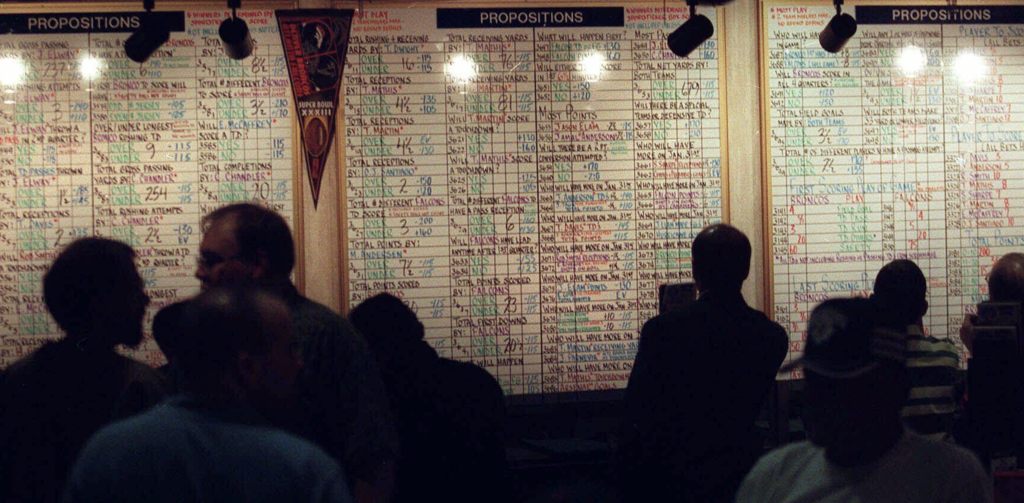
Magliulo, whose Las Vegas bookmaking career spans the era of handwritten boards, telephone updates and modern screens, places the line within that physical world of casino sportsbooks: numbers had to be received, written, compared and changed in front of a room full of customers. Information did not travel at uniform speed. The bettor who knew a quarterback was out—or simply knew that another shop had already moved—could race to a counter that was still dealing the old price.
Blair Rodman, a veteran professional bettor and historian, describes a business in which few people truly originated lines. Martin sought the number at which he could no longer decide which side he wanted. Sharp action corrected mistakes.
Roxborough industrialized the process through Las Vegas Sports Consultants in the 1980s. Many casinos subscribed rather than originate every market. Roxborough later co-founded America’s Line, carrying odds into more than 120 North American newspapers.
Manteris remembers Martin and then Roxborough as credible central sources. Today, he said, there is “no clear-cut, simple answer.” Each operator is obligated to do its own homework with power ratings, algorithms and formulas, but it cannot pretend competitors do not exist. The book makes a number, checks consultants or market screens, considers where sophisticated bettors have already played and decides how far it is willing to stand apart.
Information Is Everywhere - On & Off The Screen
That is a fundamental historical change. A generation ago, bookmakers copied a recognized originator because information was scarce. Today, they converge because information is abundant and any off-market price can be attacked almost instantly.
Avello remembers an even more tactile system. At the Stardust (the base of operations for the real-life Rosenthal, played by Robert De Niro in Casino), bookmakers made manual power ratings. A runner at the Stardust relayed the opening line and later moves by payphone. Then a printer service delivered updates. Differences lasted longer, giving skilled bettors time to find and exploit them. At one point, the payphones outside the Stardust's sportsbooks were the busiest in the nation.
Real-time screens ended much of that delay. Offshore books with high limits and sharp customers—most notably Betcris and Pinnacle—became influential sources of price discovery. A respected bet in Costa Rica could move Las Vegas within seconds. Mobile technology then placed that global market in every customer’s pocket.
Franzi was part of an earlier version of the same mechanism. He played early at books and, in Manteris’ phrase, helped “straighten out” the lines. The bookmaker supplied the first opinion. The bettor supplied a costly correction. Other shops observed the correction and updated their boards.
The system is now faster and vastly larger, but it still depends on that exchange of risk for information.
The line that once occupied a few columns of agate now changes continuously on broadcasts, apps and second screens. Its delivery has transformed. Its purpose has not.
Today’s same-game parlay ads and live odds integrations descend from the same insight. The line does not merely describe the game. It creates another way to watch it.
The Number Is Never the Outcome
When a game lands exactly on the spread—or a meaningless final touchdown produces a backdoor cover—the line can appear almost prophetic. It is not.
Murray noted the Week 3 Eagles-Rams game last season. The Eagles were favored by 3.5 points. Down 27-26, the Rams drove into field-goal range. Jordan Davis blocked Joshua Karty's 44-yard attempt as time expired. Davis rumbled 61 yards for a game-ending scoop-and-score.
Final score: Eagles win, 33-26.
That “meaningless” touchdown flipped the betting outcome on the spread and, potentially, the moneyline. To suspicious viewers, the ending looked scripted around the number. Inside his sportsbook, employees were as stunned as everyone else.
“We just put a number up there that we think will be a fair betting number,” Murray said. “Once the game starts, we don’t know what the hell is going to happen either.”
Avello made the same point with props. People remember when a quarterback projection of 276 yards lands near 276. They forget the games in which he throws for 176.
A betting line is not a prediction carved in stone. It is a price at a moment in time—a compressed expression of data, injuries, weather, matchups, public perception, expert opinion and every wager accepted so far.
More precisely, it is a family of prices. The spread tells what separates the teams. The vig tells what the book charges to take a side. The limit tells how confident the operator is in accepting disagreement. The movement tells what new information and money have arrived. The closing line records where the negotiation ended.
It begins with someone willing to be wrong first. It improves when other people put money behind their disagreement. And by kickoff, the closing line has become the market’s best collective answer to a question whose real answer has not happened yet.
That is where betting lines come from.
Bibliography & Source Information:
Original reporting and interviews: Included Johnny Avello, Joey Feazel, Derek Stevens, Mike Palm, Billy Walters, Roxy Roxborough, John Murray, Tarek Mansour, Thomas Gable, Chris Andrews, Adam Bjorn, Art Manteris, Vinny Magliulo, Blair Rodman, a FanDuel trader, a Novig market maker, and a presentation by Hayden Ware at BetBash.
Book references: Art Manteris, The Bookie: How I Bet It All on Sports Gambling and Watched an Industry Explode; Billy Walters with Armen Keteyian, Gambler: Secrets From a Life at Risk; Blair Rodman, All About Sports Betting: The Definitive Guide.
Data: American Gaming Association, Citizens Financial Services, Paradigm (Kalshi), Company Earnings Reports, State Gaming Reports

Promo Code: BOOKIESBR250
Caesars Sports Welcome Offer Ts and Cs: Must be 21+ and physically present in AZ, CO, IL, IN, IA, KS, KY, LA, ME, MD, MA, MI, MO, NJ, NY, NC, OH, PA, TN, VA, WV, WY or Washington, DC. New users only. Must register using eligible promo code. Min. qualifying bet amount: $1. Tokens max. bet amount: $25 per token. Tokens bet max. add'l winnings: $2,500 per token. Token(s) expire 14 days after receipt. Not reissued for voided/pushed bets. Void where prohibited. See Caesars.com/promos for full terms. Know When To Stop Before You Start®. Gambling Problem? CO, IL, KY, MD, MI, MO, NJ, TN, VA, WV, WY, KS (Affiliated with Kansas Crossing Casino), ME (Licensed through the Mi’kmaq Nation, Penobscot Nation, and Houlton Band of Maliseet Indians, federally recognized tribes located in the State of Maine), NC (Licensed through Tribal Casino Gaming Enterprise), PA (Affiliated with Harrah's Philadelphia): If you or someone you know has a gambling problem, crisis counseling and referral services can be accessed by calling 1-800-GAMBLER (1-800-426-2537) or MD: visit mdgamblinghelp.org or WV: visit 1800gambler.net; AZ: Call 1-800-NEXT-STEP; IN: Call 1-800-9-WITH-IT; IA: Call 1-800-BETSOFF; MA: Call 1-800-327-5050 or visit gamblinghelplinema.org, NY: Call 877-8-HOPENY or text HOPENY (467369); LA (Licensed through Horseshoe Bossier City and Caesars New Orleans) Call 1-800-522-4700, Washington, DC (OLG Class A licensed Operator): Call 1-800-MY-RESET. ©2026, Caesars Entertainment
 Next Premier League Manager Sacked Odds: Carrick on Brink After Bournemouth Run Riot
  Premier League Top 4 Betting Odds 2026/27 -Brighton, Brentford Continue to Push
  Ballon d'Or Betting Odds: Kane Favourite Over Mbappe, Yamal Ahead of Tonight's Ceremony
  Premier League Winner Odds: Arsenal Odds-On As Man City Await Punishment
  Next Crystal Palace Manager Odds: Dyche Favourite to Replace Struggling Sage
  Expert Football Betting Tips - Today's Best Football Tips For Sevilla vs Osasuna
Comments