
Best Prediction Market Apps | Complete Prediction Markets Guide for 2026
Three CFTC-regulated platforms now lead the US prediction markets category: Kalshi, Polymarket, and OG. After the Third Circuit’s April 6 ruling that the Commodity Exchange Act preempts state gambling laws for sports event contracts, the regulatory ceiling on these apps just lifted. Below you’ll find a side-by-side comparison, an in depth review of each, the May 2026 legal context, and a step-by-step on how to start trading.

Promo Code: BOOKIES
Polymarket Prediction Welcome Offer Ts and Cs: 18+ Only. Restrictions and eligibility requirements apply. Not available in all jurisdictions. Trading is risky. 100% loss can occur. See polymarket.com/tos for more information. The Polymarket US App serves as an independent software provider and affiliate of Polymarket US and Polymarket Clearing, the CFTC-regulated exchange and clearing organization.

Novig Prediction Welcome Offer Ts and Cs: Must be 21+ to participate, Limit of one offer per user, void where prohibited

Promo Code: BDC
Underdog Prediction Welcome Offer Ts and Cs: No Purchase necessary. ; new users must make a first-time deposit. Milly Bucks have no cash value. Bonus entries are not cash, must be played through 1x within the turnover period (14 days unless otherwise stated), can't be used on prediction picks or entries paying under 2x, and are forfeited if unused. All 20 questions must be completed within 60 days. 18+ (19+ AL, NE; 21+ AZ, MA, VA). Must be physically present in an eligible state. Void where prohibited. Gambling problem? Call 1-800-GAMBLER.

Promo Code: BOOKIES
OG Market Prediction Welcome Offer Ts and Cs: Must be 18+ to participate. T&Cs apply.

Promo Code: BOOKIES
ProphetX Prediction Welcome Offer Ts and Cs: 18+. T&C Apply. Play Responsibly
Best Prediction Market Apps Compared
Kalshi is the best overall prediction market app for US traders. Polymarket leads on political markets and global liquidity. OG is the best for sports-first trading with parlay-style combined positions. All three platforms are federally regulated and accept US traders in 40+ states as of May 2026. Data is verified weekly.
| App | Best for | Regulatory status | Trading fees | Payout speed | Bonus | States |
| Kalshi | Best overall | CFTC DCM (independent) | 0.5–1% per contract | ACH 1–3 business days | $10 with code BOOKIES | 40 + DC |
| Polymarket | Politics + liquidity | CFTC DCM (US version) | No platform fee - Polygon gas only | Instant via USDC | [Bookies.com promo] | 41 + DC |
| OG | Sports + entertainment | CFTC via CDNA (Crypto.com) | $0.02 flat per contract | Within 24 hours | Up to $100 in rewards | 40+ states |
What is a prediction market app?
A prediction market app offers a legal alternative to traditional sportsbooks by operating more like a stock exchange. Instead of placing a standard bet against the house, users buy, sell, and trade “Yes” or “No” contracts tied to sports games and other real-world events.
The key difference is pricing. On a traditional sportsbook, the odds are set by the bookmaker. On a prediction market app, users help determine the price through buying and selling activity. Contracts usually start at even odds, then move up or down depending on demand and market sentiment.
Prediction markets are platforms that allow users to trade shares based on the outcome of events such as elections, award shows, economic trends, weather phenomena, cultural benchmarks, stock and commodities markets, government data, health trends, news developments and - most lucratively - sports.

How does event contract pricing work?
Every market has a Yes contract and a No contract. The two prices always sum to roughly $1 (minus the bid-ask spread). If Yes trades at $0.62, No trades at about $0.38.
Buying 100 Yes contracts at $0.62 costs $62 and pays $100 if you’re right, a profit of $38, or about 61%. You can place limit orders (you set the price) or market orders (you take the current price).
Who regulates prediction markets in the US?
The Commodity Futures Trading Commission (CFTC) has primary federal jurisdiction. Kalshi holds an independent Designated Contract Market (DCM) license. Polymarket’s US version operates under CFTC oversight. OG operates through Crypto.com Derivatives North America (CDNA), a CFTC-registered exchange and clearinghouse. CFTC oversight covers fund segregation, market manipulation rules, KYC requirements, and contract self-certification. The CFTC public comment period on event contract rulemaking closes April 30, 2026.
Why are prediction markets legal in states without sportsbooks?
Prediction markets are registered with the federal Commodity Futures Trading Commission (CFTC) as Designated Contract Markets, the same regulatory category as the Chicago Mercantile Exchange. The contracts are classified as "swaps" under the Commodity Exchange Act, not as bets.
That federal classification preempts state gambling law in most cases. CFTC-regulated platforms can offer sports event contracts in Texas, California, Georgia, and Florida, states with no legal sportsbooks.
MORE INFO: Read this article by Bill Speros "Prediction Markets Explained"
Best Prediction Markets Apps in 2026
- Kalshi for its CFTC Designated Contract Market license and broad market depth.
- Polymarket for political markets and global liquidity.
- OG for sports event contracts with parlay-style combined positions.
1. Kalshi: Best overall prediction market app
900+ active markets across sports, politics, economic data, pop culture, weather, and crypto prices. Kalshi is the only US prediction market with an independent CFTC Designated Contract Market license, and that regulatory standing has carried its sports event contracts through every state-level legal challenge, including the New Jersey case that produced the April 2026 Third Circuit ruling.
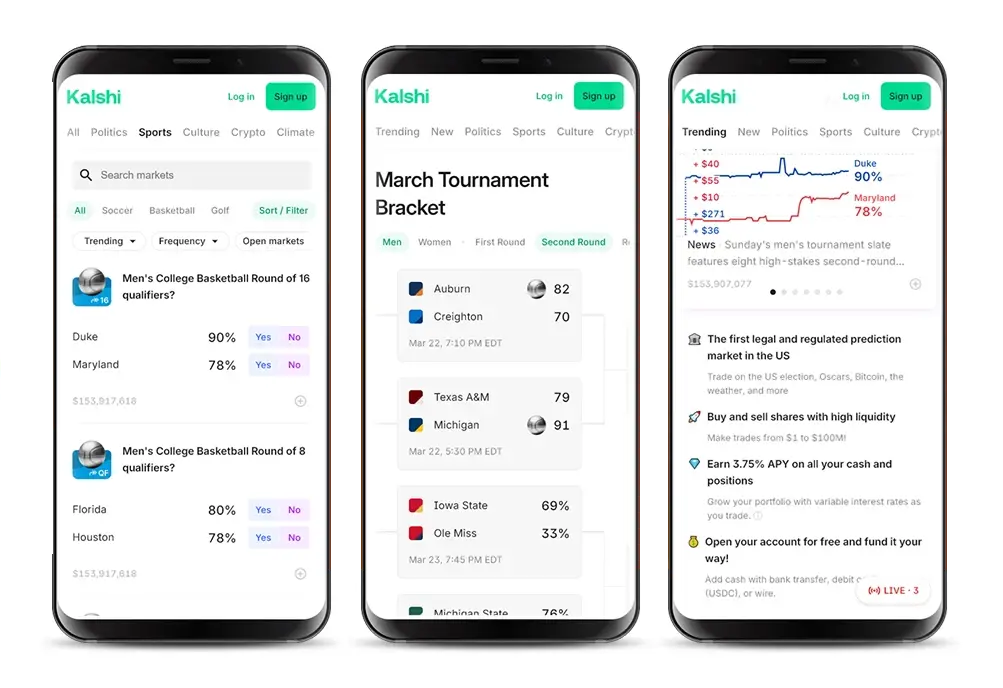
Trading fees range from 0.5% to 1% per contract, with volume-based discounts for active traders. Withdrawals process via ACH within one to three business days. The mobile apps carry a 4.6/5 rating on the App Store and 4.5/5 on Google Play.
Liquidity on marquee events, NBA Playoffs, Super Bowl, presidential elections, is the deepest in the US market. For most US traders, Kalshi is the right place to start.
Why is Kalshi the best prediction market app?
- CFTC DCM license, the gold standard for US prediction markets
- Deepest liquidity on US sports and politics
- Available in 40 states plus DC
- "Predictive Insights" feature shows full price history per contract
- Promo code BOOKIES delivers a $10 trading bonus after a $10 qualifying trade
What are Kalshi’s drawbacks?
- No 24/7 customer support
- Trading fees are slightly above some competitors
- No crypto deposit or withdrawal options
Kalshi at a glance
| Sign-up bonus | $10 trading bonus with code BOOKIES (after $10 qualifying trade) |
| Trading fees | 0.5–1% per contract |
| Payout speed | 1–3 business days via ACH |
| Banking | ACH, wire, debit card, Apple Pay |
| App ratings | 4.6/5 App Store | 4.5/5 Google Play |
| Available in | 40 states + DC |
| Restricted | AR, AZ, CT, IL, LA, MA, MD, MI, MT, NV, OH |
| Best for | US traders who want the most regulated, most liquid platform |
2. Polymarket: Best for politics and global liquidity
$3.5+ billion in volume during the 2024 US presidential election cycle. Polymarket has remained the global leader on political event contracts since, and a US-compliant version operates under CFTC oversight while preserving the deep international liquidity that built the platform’s reputation.
No platform trading fees. Polymarket runs on the Polygon blockchain and settles all contracts in USDC, the dollar-pegged stablecoin. The only cost per trade is Polygon network gas, which runs about $0.01.
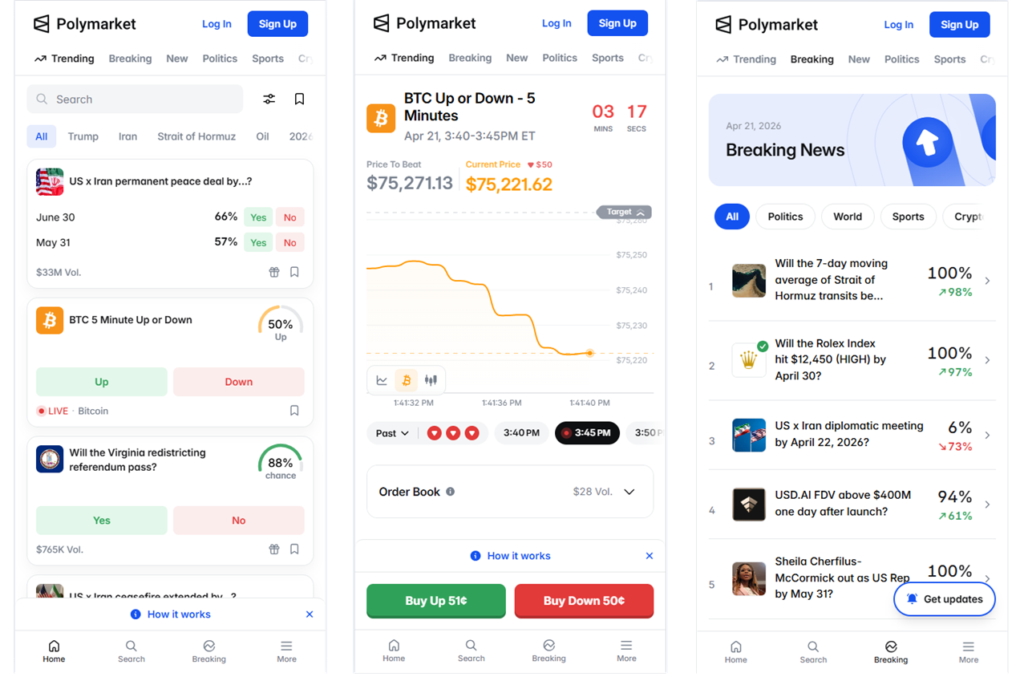
Politics is where Polymarket dominates. Granular markets exist for Senate control, individual gubernatorial races, primary outcomes, and even county-level results. The crypto-native architecture is a 10-minute learning curve for first-time users.
Why choose Polymarket?
- Deepest political event contract liquidity in the world
- No platform trading fees — just Polygon gas (~$0.01)
- Instant settlement and payouts via USDC
- Public on-chain price history for every contract
- Customizable dashboard for tracking multiple markets
What are Polymarket’s drawbacks?
- Steep learning curve for users new to crypto wallets
- US version restricted in AZ, IL, MA, MD, MI, MT, NV, OH
- Sports liquidity is thinner than Kalshi outside major events
Polymarket at a glance
| Sign-up bonus | [Bookies.com Polymarket promo - confirm code & value] |
| Trading fees | No platform fees; Polygon gas under $0.01 |
| Payout speed | Instant via USDC; 1–2 days for fiat conversion |
| Banking | USDC required; fiat on-ramp via partners |
| App ratings | 4.5/5 (mobile web) |
| Available in | 41 states + DC (US version) |
| Restricted | AZ, IL, MA, MD, MI, MT, NV, OH |
| Best for | Political traders, crypto-native users, high-volume traders |
OG.com: Best for sports event contracts
$0.02 flat per contract — the cleanest fee structure in the category. OG launched on February 3, 2026 as a new prediction market platform powered by Crypto.com Derivatives North America (CDNA), a CFTC-registered exchange and clearinghouse.
500+ sports markets across NFL, NBA, MLB, NHL, soccer, tennis, UFC, F1, and more. OG supports parlay-style combined positions on team-level markets like game winners, point spreads, and totals, a feature most prediction markets do not offer.
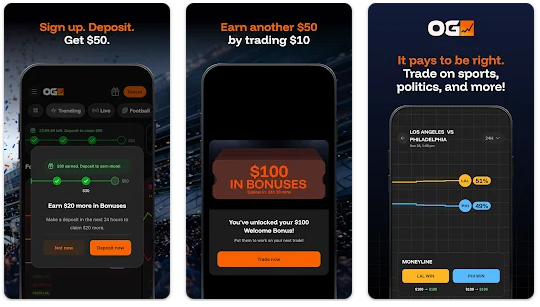
CEO Nick Lundgren previously led Crypto.com’s entry into US sports event contracts in late 2024 as president of CDNA. The launch promo gives the first one million users up to $500 in rewards, layered on top of a VIP program tied to UFC, Formula 1, UEFA Champions League, and Crypto.com Arena partnerships.
Why choose OG?
- CFTC-regulated through CDNA — same federal framework as Kalshi and Polymarket
- Flat $0.02 per contract — the most transparent fee structure in the category
- Parlay-style combined positions on team-level markets (game winner, spread, totals)
- 500+ sports markets across all major US and international leagues
- Up to $100 in rewards and bonuses through Bookies.com
- Social features and leaderboard for traders who want a community layer
What are OG’s drawbacks?
- Newer platform — launched February 2026, so historical track record is shorter than Kalshi or Polymarket
- Player prop parlays not yet supported (team-level markets only)
- Flat $0.02 per contract is not the cheapest option for very high-volume traders
- State availability still expanding — verify in-app before depositing
OG at a glance
| Spec | Detail |
| Sign-up bonus | Up to $100 in rewards & bonuses [confirm Bookies.com OG code] |
| Trading fees | $0.02 flat per contract |
| Payout speed | Within 24 hours |
| Banking | ACH, debit card, Apple Pay; crypto via Crypto.com integration |
| Operator | Crypto.com Derivatives North America (CDNA), CFTC-registered |
| Sports coverage | NFL, NBA, MLB, NHL, soccer, tennis, UFC, F1, more |
| Available in | 40+ states (verify in-app) |
| Best for | Sports-first traders who want CFTC-regulated parlays and entertainment markets |
April 2026 Legal and Regulatory Updates
A federal appeals court ruled on April 6, 2026 that CFTC-regulated prediction market apps can offer sports event contracts in states that have tried to block them under gambling law. Two more federal developments, Ninth Circuit oral arguments and a CFTC rulemaking deadline, land before May.
April 2026 is the most consequential month in prediction markets history. Three federal developments are reshaping the regulatory landscape for the rest of the year.
Which states restrict prediction market apps?
CFTC-regulated prediction market apps are currently restricted in some combination of these states, depending on the platform: Arizona, Arkansas, Connecticut, Illinois, Louisiana, Maryland, Massachusetts, Michigan, Montana, Nevada, New Jersey (now disputed post-Third Circuit), New York (Crypto.com-affiliated platforms), and Ohio.
All other states permit at least one regulated prediction market app for residents 18 and older (21+ in select states). Verify availability on the platform before depositing — state restrictions can shift rapidly during active litigation.
Full state list
All three available (37 states + DC): AL, AK, CA, CO, DE, DC, FL, GA, HI, ID, IN, IA, KS, KY, ME, MN, MS, MO, NE, NH, NM, NC, ND, OK, OR, PA, RI, SC, SD, TN, TX, UT, VT, VA, WA, WV, WI, WY
Partial (4 states): CT, MT, NJ, NY
Restricted on 2+ platforms (10 states): AZ, AR, IL, LA, MD, MA, MI, NV, OH
How to Choose a Prediction Market App
Start with CFTC regulation. Then evaluate fees, payout speed, market depth, state availability, and bonus terms in that order. Kalshi wins on regulation and depth. OG wins on fee transparency and sports parlays. Polymarket wins on global liquidity.
Six criteria separate the right pick from the wrong one. Walk through them in order before opening an account.
1. Is the platform CFTC-regulated?
Always start here. Federal oversight provides fund segregation, customer protections, and federal preemption against state-level shutdowns. Kalshi holds an independent Designated Contract Market license. Polymarket’s US version operates under CFTC oversight. OG operates through CDNA, a CFTC-registered exchange.
2. What are the trading fees?
OG charges a flat $0.02 per contract — the simplest math in the category. Kalshi charges 0.5–1% per trade with volume-based discounts. Polymarket has no platform fees, only Polygon gas of about $0.01 per transaction.
The right number depends on your trade size and frequency: percentage fees favor smaller positions, flat fees favor larger ones.
3. How fast are payouts?
Polymarket settles instantly in USDC via the Polygon blockchain. OG processes withdrawals within 24 hours. Kalshi processes ACH withdrawals in one to three business days.
If quick access to winnings matters, Polymarket and OG move fastest. If you prefer pure fiat banking with no crypto exposure, Kalshi is the right choice.
4. How deep is the market liquidity?
Liquidity is the single most underrated factor. A market with thin liquidity will have wide bid-ask spreads, which means you pay more to enter and earn less when you exit.
Kalshi and Polymarket lead on liquidity for marquee events. OG’s liquidity is growing rapidly across sports markets. Stick to high-volume contracts when starting out.
5. Is the app available in your state?
Check the platform’s state availability before creating an account. Restricted-state users will be blocked at deposit or trade. CFTC-regulated platforms operate in Texas, California, Georgia, and Florida — states with no legal sportsbooks.
6. Is the bonus worth the trading requirement?
Sign-up bonuses on prediction markets are smaller than sportsbook bonuses but easier to clear. Kalshi’s $10 bonus (with promo code BOOKIES) requires a $10 qualifying trade. OG offers up to $100 in rewards and bonuses for new users. Polymarket runs deposit-match promotions that vary by period. Most prediction market bonuses do not carry the rollover requirements common to sportsbooks.
Prediction Markets vs Traditional Sportsbooks
Prediction markets are peer-to-peer exchanges regulated by the federal CFTC. Sportsbooks operate against the house with fixed odds and state-level licensing. Prediction markets let you exit positions early; most sportsbooks only offer cash-out on select markets.
The table below summarizes the structural differences. Both share an audience but operate under different rules, different economics, and different regulatory frameworks.
| Factor | Prediction markets | Traditional sportsbooks |
| Pricing | User-driven, dynamic probabilities | Fixed odds set by oddsmakers with house edge |
| Counterparty | Other users (peer-to-peer) | The house |
| Exit before settlement | Anytime — buy or sell positions | Cash-out feature only when offered |
| Market types | Sports, politics, economics, culture, weather, crypto | Sports primarily |
| Regulation | CFTC (federal) | State gaming commissions |
| State availability | 40+ states for top platforms | Varies state by state (38 currently) |
| Bonus structure | Small trading bonuses, minimal rollover | Larger welcome offers with playthrough |
| Account verification | KYC + SSN required | KYC + SSN required |
| Available in TX, CA, GA, FL | Yes (CFTC platforms) | No traditional sportsbooks |
| Tax reporting | 1099-B forms | W-2G for large wins |
When should you choose a prediction market over a sportsbook?
Choose a prediction market when you live in a state without legal sportsbooks, when you want exposure to non-sports events (politics, economics, culture), when you want to exit a position mid-game, or when you trade actively enough that lower fees matter more than promo value.
When should you choose a sportsbook over a prediction market?
Choose a sportsbook when you want the largest welcome bonuses, when you prefer fixed odds and parlay-style wagering, when your state has legal sportsbooks and you only bet on sports, or when you value the depth of in-play markets and prop bets.
Prediction Markets for DFS Players

Promo Code: BOOKIES
Novig Daily Fantasy Welcome Offer Ts and Cs: Must be 21+. No purchase necessary. Promo for new users only. Void where prohibited. See Terms of Use for eligibility.
Prediction markets pay every correct contract at $1, while DFS pays only the top of a contest field. The research overlap is high, player news, weather, injuries, and pace metrics all transfer, but the scoring model is different.
If your wagering identity is built around daily fantasy sports, prediction markets are a natural extension. The skill set transfers directly: research, pricing inefficiency, edge identification, and disciplined position sizing.
How to Sign up for a Prediction Market App
Choose a platform, verify eligibility, complete KYC with your SSN, claim a bonus, deposit funds, place your first trade, and withdraw winnings. The full flow takes 24–48 hours including KYC verification.
Account setup is similar across CFTC-regulated platforms. The seven-step walkthrough below uses Kalshi as the worked example. The flow is nearly identical for OG. Polymarket adds a USDC wallet step but is otherwise comparable.
- Choose a platform. For most US traders, Kalshi is the right starting point because of its CFTC DCM license. Use the Bookies.com promo code BOOKIES at signup to claim a $10 trading bonus.
- Verify eligibility. You must be 18 or older (21+ in select states) and physically located in a state where the platform operates. The app will run a geo-check at signup.
- Create your account. Provide name, email, phone, date of birth, address, and Social Security Number. KYC verification typically completes in 24–48 hours.
- Claim your bonus. Enter promo code BOOKIES during signup if you are using Kalshi. Bonuses must be claimed at registration — retroactive credits are rare in the category.
- Deposit funds. Kalshi and OG accept ACH, wire, debit card, and Apple Pay. Polymarket requires USDC funded through the Polygon network. Minimum deposits start at $1 on Kalshi.
- Place your first trade. Browse markets by category, select a contract, decide Yes or No, set your quantity, and either accept the market price or post a limit order at your target price. Trade execution is instant.
- Withdraw your winnings. Settled funds can be withdrawn anytime via the same banking method used to deposit. Kalshi ACH withdrawals process in 1–3 business days. Polymarket USDC withdrawals settle within an hour. OG processes withdrawals within 24 hours.
Risks and Responsible Trading ⚠️
Prediction markets carry liquidity risk (thin markets can’t be exited), regulatory risk (state injunctions can change availability fast), and tax obligations (1099-B reporting on most CFTC platforms). Treat them as speculative entertainment, never as income.
Prediction markets are not risk-free. Four risk categories matter for every trader.
What is liquidity risk on a prediction market?
Niche markets can sit unmatched for hours — small-market daytime baseball games, obscure pop culture outcomes, low-volume political contracts. If no one is on the other side of your trade, you cannot exit.
Stick to high-volume contracts when starting out, where bid-ask spreads are typically 1–2 cents and exits are quick. Niche markets become viable as your experience grows but should never represent the bulk of your portfolio.
What is the regulatory risk?
State-level injunctions can change platform availability rapidly. Massachusetts blocked Kalshi sports contracts in March 2026; the Third Circuit overruled New Jersey’s injunction in April. If you trade across multiple platforms, periodically verify state availability for each.
How are prediction market profits taxed?
CFTC-regulated platforms typically issue 1099-B forms for trading activity. Profits are taxed as short-term capital gains — your ordinary income tax rate — rather than as gambling winnings.
Polymarket’s on-chain settlement carries its own reporting nuances if you fund and withdraw via crypto. Consult a tax professional before relying on any specific treatment.
How do you trade responsibly?
Prediction markets are designed to feel like a brokerage, but the behavioral patterns can mirror gambling — chasing losses, scaling positions after a win, trading on impulse. Set a fixed monthly budget, never trade with money allocated to bills or savings, and take regular breaks.

Best Prediction Markets Apps FAQs
What are the best prediction markets apps in the US?
Kalshi, Polymarket, and OG are the three top prediction markets apps in the US for 2026. Kalshi is the top overall pick for its independent CFTC Designated Contract Market license and deep market coverage. Polymarket leads on political markets and global liquidity. OG is the strongest sports-first prediction app with parlay-style combined positions and a flat $0.02-per-contract fee.
Are prediction markets legal in the United States?
What is the difference between a prediction market app and a sportsbook?
Is Kalshi better than Polymarket?
How does OG compare to Kalshi?
Polymarket vs OG: which is better?
Do prediction market apps charge fees?
How fast are payouts on prediction market apps?
About the Author

About this guide
This guide is updated weekly by the Bookies.com prediction markets team. Comparison data is verified against each platform’s public terms and conditions every Monday. Legal timeline updates are tracked through CFTC notices, federal court filings, and state regulatory bulletins.