
2026 World Cup: Economic Impact by U.S. Host City

The largest World Cup in the event’s history is slated to take place across North America this summer. The 2026 World Cup will involve 48 teams from across the globe playing in the United States, Canada and Mexico.
Given how the 2026 event marks the first return to the USA in 32 years, it’s understandable that the World Cup has generated outsized excitement, both at home and abroad. And soccer betting options that didn’t exist outside of Nevada for that 1994 tournament are available now.
A total of 78 matches will be held across 11 U.S. World Cup host cities, spanning from coast to coast, in Atlanta, Boston, the Bay Area, Dallas, Kansas City, Miami and Seattle, among others. The tournament opens June 11 when Mexico hosts South Africa in Mexico City.
America’s state-by-state approach to sports betting legality leaves many of those interested in wagering on the event in the lurch. Four states hosting matches (Massachusetts, Missouri, New Jersey and Pennsylvania) having legal, regulated online sports betting apps plus retail options.
To get a sense of the economic and wagering impact that World Cup 2026 USA will have on those 11 cities, Bookies.com broke down the numbers on this summer’s biggest sporting event, with more than $5 billion in 2026 World Cup economic impact expected across the month-long tournament. The games in Canada and Mexico are not accounted for here.
Explore the full city-by-city breakdown in this interactive graphic:
The $556M Visitor Spending Picture
The World Cup’s total economic impact – with figures from Data Appeal Company / Mabrian (February 2026) – is projected at $556 million. The region projected to have the greatest windfall is the New York/New Jersey area, at $67 million.
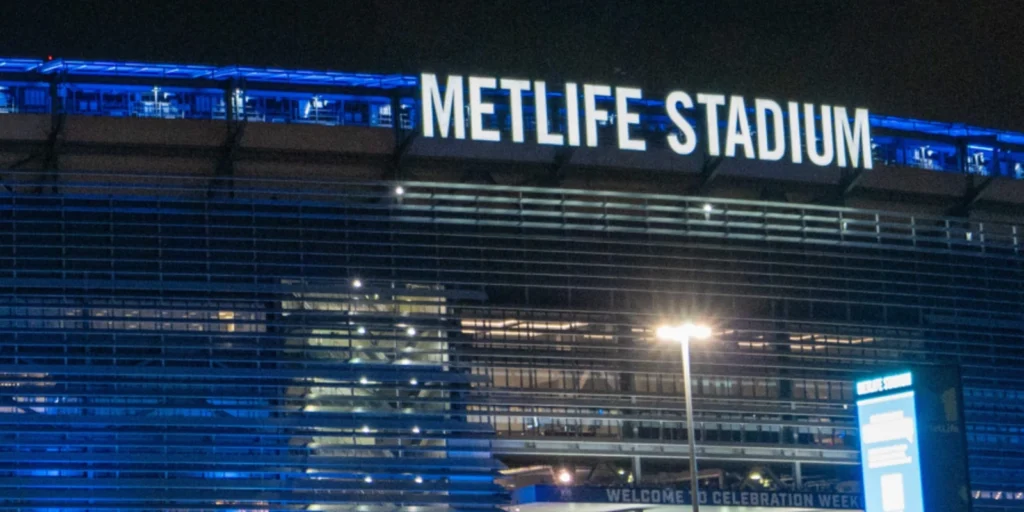
Such an outcome would make sense, as MetLife Stadium will host the final of the 48-team event in 2026, plus seven other matches. The New York sports betting market is the largest in the nation, with more than $26.3 billion in handle in 2025, and New Jersey also has multiple operators from which to choose.
The Los Angeles region is expected to see $59 million in 2026 World Cup economic impact, with the Dallas-Fort Worth metroplex third, at $58 million. The Dallas region’s place near the top makes sense, given that AT&T Stadium will host an event-high nine matches during the 2026 World Cup, including a semifinal on July 14.
The eight matches slated for SoFi Stadium in Inglewood, including the U.S. team’s opener against Paraguay on June 12, helped juice the city’s visitor spending projection.
The DFW metroplex pulled down the largest total economic impact projection of the 11 cities surveyed, at $1.8 billion, well ahead of the next closest contender (Houston, at $1.5 billion). The economic impact varies widely for each city, depending on the sources.
Atlanta, which had the fourth largest visitor spending projection, at $52 million, while Seattle was the only other metropolitan area projected to rake in more than $50 million in visitor spending, finishing fifth at $51 million.
Atlanta is slated to host eight events at Mercedes Benz Stadium downtown. Seattle’s Lumen Field is set for seven matches, with both cities hosting one quarterfinal.
ALSO SEE: Ranking the 2026 World Cup Host Cities by Best Atmosphere
Analysis Of How Folks Will Spend
Of the $556 million figure cited by Data Appeal Company and Mabrian, $280 million (just over 50%) is expected to come from food and beverage spending. Accommodations account for 32.5% (or $181 million) in spending, with hotel rates surging 7% to 25% in June and more than 46% for knockout rounds. Finally, 17% (or $95 million) is expected from transportation (flights, local transit, rideshares and rental cars).
The top five cities (New York/New Jersey, Los Angeles, Dallas, Atlanta and Seattle) are expected to capture 52% of total visitor spending, at $287 million between them.
The $556 million figure cited in the survey falls in line with other top-tier worldwide sporting events such as the Olympics. The 2024 Summer Games in Paris generated around $920 million in visitor spending, meaning the 2026 World Cup is projected to generate 60% of that amount.
See the interactive widget above, put together by the team at Bookies.com, for top-notch insights about 2026 World Cup economic impact.
City-By-City Breakdown
With 78 matches held across 11 U.S. cities, and 1.24 million international visitors expected, it’s no wonder that economists expect big things across the country this summer.
Dallas, Houston and the New York/New Jersey region are the top line generators for total economic impact. But the Emerald City of Seattle is expected to have the third-largest total impact figure, estimated at $929 million.
Throw in the fact that Seattle’s hotel increase of 17% is in line with other top-line economic movers, and you have a decent idea of why economists expect big things for World Cup 2026 USA in and around Lumen Field, home of the Super Bowl champion Seattle Seahawks.
After Seattle, you have quite a dropdown in economic impact before you find the next closest city (Kansas City, at $653 million), followed by Los Angeles ($594 million) and Miami ($550 million).
Daniel McIntosh, the faculty director of the Sports Business Program and a teaching professor in the Department of Marketing at Arizona State University, told Bookies.com about the economic impact of the World Cup. He said that host markets with higher shares of international visitors, as well as those with larger stadium capacities and more matches – along with strong hotel inventory and an established tourism industry – stand to experience the greatest economic impacts from the World Cup.
Given those parameters, McIntosh said it would make sense for markets like New York, Dallas and Los Angeles to dominate, though smaller markets hosting matches shouldn’t be written off.
“The most defensible metric is net new spending from out-of-region visitors. In other words, dollars that would not have been spent in that host city but for the World Cup,” McIntosh said. “Spending by local residents generally represents substitution rather than new economic activity. If a Phoenix resident spends $200 at a football game instead of at a movie theater or restaurant, that is a reallocation within the same economy, not net growth.”
The Betting Landscape: Where The 11 U.S. Cities Hosting Matches Stand
Four of the nine World Cup host states (and five out of the 11 cities) have online sports betting on the books, leading to potential World Cup betting confusion this summer.
The only states with two World Cup host cities apiece (California and Texas) do not allow legal, regulated sports betting at all. Soccer fans attending games in the Bay Area, Dallas, Houston, Los Angeles and Atlanta will not have access to legal World Cup betting options. Those cities account for 38 of the 78 matches in the USA.
California and Texas, which have a combined Census population of just over 71 million people, have no plans to add legal sports betting in the near term. California tribal interests appear set to try and get sports betting on the ballot, though the earliest that’d happen is 2028 (or later). In Texas, Lt. Gov. Dan Patrick has held up progress on wagering legalization.
On the flip side, America’s newest legal sports betting market (Missouri) is slated to host six matches this summer. Missouri sports betting operators have taken in more than $900 million in total wagering handle across the Show-Me State’s first two months of operation.
Missouri’s launch on Dec. 1, 2025, came roughly six months ahead of Argentina’s opener inside Arrowhead Stadium on June 16. So Missouri sports betting customers have ample time to take advantage of customer acquisition opportunities.
Finally, Seattle’s place in Washington state’s tribal-only wagering market means that prospective sports bettors in the region will have to head to a tribal sportsbook to bet, with no mobile wagering options to choose from.
Boston, NY/NJ, Kansas City and Philadelphia are in states with robust mobile sportsbook markets. Florida has one operator, Hard Rock Bet, so folks in Miami will use that one for a legal online wager.
What Could World Cup Handle Be
No formal U.S. World Cup betting projections have been released, but there’s strong reason to suspect that global wagering handle could clear $200 billion for the first time.
Industry insiders such as Brendan Bussmann, the managing partner of B Global, believe that the 2026 event will shatter wagering records set in 2022.
“With the advent of the World Cup coming to America, there will be an increased interest in the event,” Bussmann told Bookies.com. “While soccer has not always been the highest priority for Americans, the ‘other football’ on the home turf will definitely increase the level of wagering. If the Americans do well, it will only further be enhanced.”
2022 vs. 2026 World Cup Betting
To put that in perspective, the American Gaming Association estimated that that 20.5 million American adults wagered $1.8 billion during the 2022 World Cup, while the global handle of the 2018 event was $143 billion. And the American sportsbook industry has expanded greatly since then.
“Since the last World Cup, the legally regulated market through states have increased their footprint significantly with a majority of these venues in legally regulated markets,” Bussmann said. “The more interesting factor will be how much in addition to the local market do you get from teams visiting from other countries?
“You are already seeing a buzz around the World Cup, especially in those cities that are hosting teams and have venues. This will only enhance the level of interest and allowing people to have some additional fun by having their own stake in the game through the states that offer sports wagering.”
Risks & Headwinds
Given the current immigration uncertainty that has been a hallmark of the second Trump administration, with a 6.3% decline in international visitors to the U.S. in 2025 plus visa difficulties for foreign visitors, it seems that there’s plenty of risk to economic success at this year’s World Cup.
Much of that decline has been attributed to the increase in immigration enforcement put in place by the Trump administration, along with trade policy perceptions and general malaise towards the current American governance structure.
In an interview with Marketplace last October, Aran Ryan of Tourism Economics pegged the economic impact of that slump in foreign visitors at $31 billion, with a trickle-down effect on everything from car rental companies to restaurants and hotel chains.
“(We're) seeing it as the loss of $31 billion of spending by international visitors this year that we think would have happened otherwise,” Ryan said. “So there's about 2,400 Hampton by Hilton Hotels in the country. So a loss of $31 billion is equivalent to the annual revenue for all of those hotels for a three-year period.”
In particular, economists such as Kenneth Shropshire of the Wharton School see immigration enforcement by U.S. Immigration and Customs Enforcement (ICE) and other agencies depressing turnout for fans of African and South American nations, even with the State Department’s FIFA PASS program.
The program has added 500 U.S. consular offices worldwide to vet those from outside the country who have purchased tickets to one of the World Cup matches in The States. But the State Department has said that an interview appointment doesn’t automatically assure the purchaser that their visa will be approved.
There’s also the issue of qualification uncertainty, with several teams still trying to make the 48-team World Cup field. There are late March playoffs in Guadalajara and Monterrey, Mexico, plus four spots from UEFA to be settle in Europe at the same time.
Those matches are estimated to delay more than 30% of travel bookings, though bookings and futures bets are expected to surge once we know the full bracket for this summer’s event.
Still, with the World Cup returning to America for the first time since 1994, it seems like optimism surrounding the event has far outweighed potential risks, with the 11 American cities slated to host matches putting their best foot forward this summer.
ALSO SEE: U.S. World Cup Roster Odds
Fan Festivals & Hidden Spending
With FIFA Fan Festivals in each of the 11 cities that are hosting World Cup matches, there’s no shortage of free fun for football fans at this year’s event. Expect giant TV screens, live music and sponsor activations to the host cities. According to FIFA, more than 39 million visitors have attended one of the fan festival events since 2006. Houston projects that more than one million people will attend this year’s festival alone.
Many of those expected to head to the Space City’s fan festival won’t have match tickets, further bolstering Houston’s World Cup spending window beyond match days and helping juice the $1.5 billion in total economic impact that the Texas city is expecting in 2026.
In total, there will be 39 days with free FIFA fan festival events in 2026, giving World Cup goers and locals in each city something to look forward to as the mercury shoots upward this summer.
Key Takeaways
- More than $556 million in direct visitor spending is projected across the 11 cities hosting World Cup matches this summer, according to Data Appeal Company and Mabian, with New York/New Jersey ($67 million), Los Angeles ($59 million) and Dallas ($58 million) leading the way. Of that $556 million, 50% (or $280 million) is expected to come from food and beverage.
- In total, the U.S. is projected to rake in more than $5 billion in broader economic activity during the 2026 World Cup, per Boston Consulting Group, with Dallas ($1.5 billion), Houston ($1.1 billion), Seattle ($929 million) and New York/New Jersey ($900 million) leading the way.
- The New York/New Jersey region is expected to see the largest hotel rate increase of any U.S. city that’s hosting World Cup matches this summer, with a 25% rise in rates, according to the team at Oxford Economics.
- Five of the 11 U.S. World Cup host cities (Miami, Boston, Philadelphia, Kansas City and East Rutherford) are in states with legal online sports betting. Five more (Atlanta, Santa Clara, Dallas, Los Angeles, Houston) are in states that have zero wagering options and another (Seattle) only has tribal retail sports betting available.
- The 2026 World Cup is expected to draw more than 6.5 million visitors, well north of the 3.5 million fans that took in one of the matches held across nine cities during the 1994 World Cup, which was the last one held in the United States. The 1994 event had 24 teams, half the total for 2026.
- The 2026 World Cup betting handle is expected to shatter records, both at home and abroad. The American Gaming Association reports that $1.8 billion was spent during the 2022 event, while the 2018 global sports betting handle was more than $200 billion, or $2.2 billion per match.
- With each of the 11 U.S. cities hosting their own FIFA Fan Festivals for free, there’s an expectation that this year’s event will further bolster the more than 39 million people that have attended such an event since 2006, with more than 1 million people expected in Houston alone.
- After a 6.3% decline in international visitors to the U.S. in 2025, largely attributed to immigration enforcement and trade concerns, Tourism Economics projects that this year’s figure will return to the positive, at +3.7%, with roughly a third of that tied to World Cup attendees.
- The White House Task Force projects that more than 290,000 jobs will be created from the 2026 World Cup, with FIFA’s projections showing a $17.2 billion boost in U.S. GDP from the event alone.
- FIFA also projects that 6.5 million fans will attend one of the matches at this year’s World Cup, an 85.7% increase from the 3.5 million fans that attended one of the matches held in the U.S. during the 1994 World Cup (again, that 1994 tournament had 52 matches, compared to 104 this year).
 McLuck Free To Play Welcome Bonus; get 60 SC free! September 2026
  Hard Rock Bet Promo Code: Get $100 in Bonus Bets September 2026
  Best NFL DFS Sites & Apps For Week 2 September 2026
  Fanatics NFL Promo Code BOOKIES: Get $1,000 in Matched FanCash
  Rebet Referral Code BOOKIES: Matched Bonus Up to $100 in Rebet Cash
  Caesars NFL Promo Code BOOKIESDYW: Get Double Your Winnings on Your First 10 Football Bets
Comments