
Kalshi CEO Offers Explanation For 'Death Carveout' On 'Khamenei' Trades

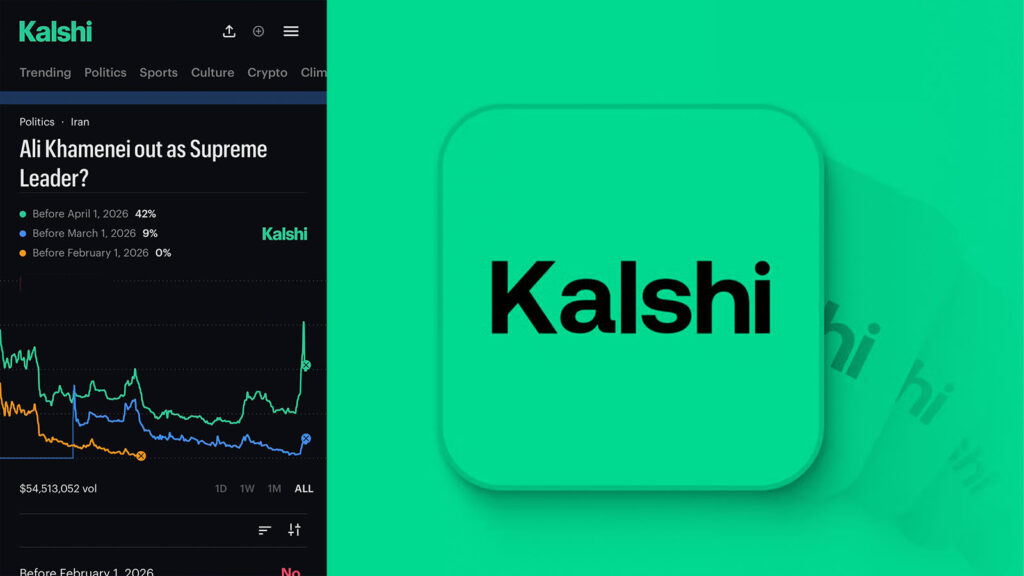
Prediction markets didn’t just react to the U.S. strike on Iran — they cashed in. But several markets, including Kalshi's 'Khamenei' trades on Iran's former Supreme Leader being removed from power.
Within hours of confirmation, more than $529 million in “U.S. strikes Iran” contracts resolved on Polymarket. And almost as quickly, the political backlash reignited. But the firestorm over several war-related trades, including Kalshi's market on "Ali Khamenei out as Supreme Leader?"
If the fight over sports-event contracts was simmering, war markets just turned up the heat.
RELATED: Prediction Markets Under Fire For War-Related Trades
Markets Move Fast. Politics Moves Faster.
On Polymarket, its “U.S. strikes Iran by…” markets — which handled more than $529 million in volume — resolved to “Yes” after President Trump’s announcement.
Kalshi, which is regulated by the CFTC, does not list contracts on specific military strikes. But its market asking whether “Ali Khamenei out as Supreme Leader?” surged to 68% before September 1 amid reports of a strike on his compound. It later settled based on its published rules — and not without controversy.
The contract has handled more than $53 million in volume since launching January 9.
Even before the strikes, Washington was already circling.
Connecticut Sen. Chris Murphy posted that he was working on legislation to ban “corrupt and destabilizing” prediction markets where insiders could “rig the game.” He included a screenshot of Polymarket’s “Will Israel Strike Gaza?” contract.
Kalshi CEO Tarek Mansour responded publicly:
“Regulated prediction markets are not allowed to do war markets. The market you're posting is unregulated and offshore.”
That was the first clarification.
This weekend, Mansour went back to X for a second — and more detailed — explanation, as frustration mounted over how the Khamenei market settled.
Mansour: “We Settled According To The Rules”
Mansour stressed that Kalshi did not change its rules midstream.
The so-called “death carveout” — which prevents the contract from settling to “Yes” in the event of death — was included in the original filing with the CFTC and displayed on the market page from the outset. After the Iran strikes began, Kalshi added a visual “Green Box” warning in the interface to highlight the carveout, but the rule itself did not change.
Traders who held YES positions argued the market should have settled differently. Mansour said altering settlement after the fact would have broken trust:
“Changing settlement because one side is unhappy would break trust in the exchange.”
He reiterated a broader regulatory point:
“As a federally regulated prediction market, we are required and feel it is important not to enable direct profiting from war, assassination, terrorism, or other violent outcomes.”
In other words: Kalshi cannot — and will not — offer contracts that directly monetize violent events.
No Trader Lost Money — Kalshi Took The Hit
In a rare move, Mansour also revealed that Kalshi reimbursed all trading fees and net losses on the Khamenei market out of pocket.
• Traders who sold at a loss before settlement were reimbursed
• Traders who did not recover their full position cost were made whole
• All fees were returned
“No trader ended net-negative,” Mansour wrote.
Kalshi itself absorbed what he described as a “substantial loss” in order to preserve trust.
He added that the company will now:
• Surface death carveouts directly in market titles
• Highlight exceptions more prominently before trades
• Implement tighter review procedures for UI warnings
This marks the second time in recent days that Mansour has publicly drawn a line between federally regulated exchanges and offshore platforms offering explicit war contracts.
Polymarket Moves Trigger 'Insider Trading' Accusations
A trader on Polymarket named "Magamyman" made more than $700,000 trading on the U.S. strike - in some cases - less than 2 hours before news of the attacks were made public. His trade of 143,393.0 shares of Khamenei out as Supreme Leader of Iran by March 31? at 14 cents turned a profit of $123,102.89.
A trade of 861,154.2 shares at "Yes" in the US strikes Iran by February 28, 2026? for 27.4 cents per share netted $195,198.47. So many shares on the Feb 28 strike represent a massive amount of liquidity for a niche political market, suggesting high confidence or high-level information.
And the US strikes Iran by March 31, 2026? market, he bought 376,566.2 shares of "Yes: at 56.1¢. That turned a profit of $165,177.74.
Among his other war market related trades: Israel strikes Iran by January 31, 2026? 278,079.6 shares of "No" at 68.7 cents for a profit of $165,177.74.
US strikes Iran by March 1, 2026? 78,000.0 shares of "Yes" at 30.6 cents for a profit of $54,105.32.
US strikes Iran by March 15, 2026? 83,438.2 shares of "Yes" at 53.8 cents for a profit of $38,544.25.
"Insider trading in broad daylight. This should be illegal no question. Pricks like this are cashing in on our service members dying. Disgusting and immoral," Sen. Ruben Gallego (D-Ariz.) posted on X in reaction to some of "Magamyman's" trades.
The Optics Problem Isn’t Going Away
The volume tied to a potential military conflict — particularly one involving American casualties — changes the regulatory and political optics.
Under 17 CFR 40.11, CFTC-regulated exchanges like Kalshi are barred from listing contracts involving terrorism, assassination, or war. Offshore platforms are not bound by those same rules.
The public, however, rarely distinguishes between the two.
And that distinction — or lack thereof — is fueling the backlash.
Supporters argue prediction markets provide informational value and hedging tools in volatile moments. Critics argue they risk incentivizing manipulation or enabling adversarial actors to influence perception through large directional trades.
The broader legal battle over sports-event contracts already appears headed toward the Supreme Court.
War markets may accelerate it.
All it takes is one headline — “Millions Profit From Iran Strike Prediction Markets” — to trigger legislative momentum.
And suddenly, the sports-event contract debate looks quaint by comparison.
 $5 Dollar Deposit Casinos Launched in Alberta October 2026
  Rebet Referral Code BOOKIES: Matched Bonus Up to $100 in Rebet Cash
  Top 5 Betting Apps Right Now October 2026
  Fliff Promo Code BOOKIES: Get up to $250 in Free Play
  Alberta Stanley Cup Betting: How to Bet on Edmonton Oilers and Calgary Flames
  Top 10 Social Casinos October 2026: Best Sites Ranked
Comments