
Kalshi Issues Insider-Trading Punishment, CFTC Re-Affirms Federal Domain Over Prediction Markets


Kalshi issued insider-trading punishment on two users, the platform said Wednesday. Following that move, the Commodity Futures Trading Commission issued its first formal enforcement advisory addressing insider trading on prediction markets under new commissioner Mike Selig.
Kalshi said these insider trading cases were "recently closed," adding it has opened 200 investigations and "frozen a number of flagged accounts. Of those investigations, over a dozen have become active cases." This marks the first notice Kalshi has issued on "insider-trading" punishments via its "Notices Page."
The advisory from the CFTC’s Division of Enforcement reinforces federally regulated prediction markets fall squarely under the anti-fraud provisions of the Commodity Exchange Act.
It is the first time the agency has publicly addressed insider-trading conduct on prediction markets since the sector’s explosive growth following the 2024 election — and since sports-event contracts began trading in January 2025.
Two Insider-Trading Cases Detailed
Both matters were investigated and penalized by Kalshi before being reported to the CFTC, as required under federal law for Designated Contract Markets (DCMs).
Candidate Trading On His Own Race
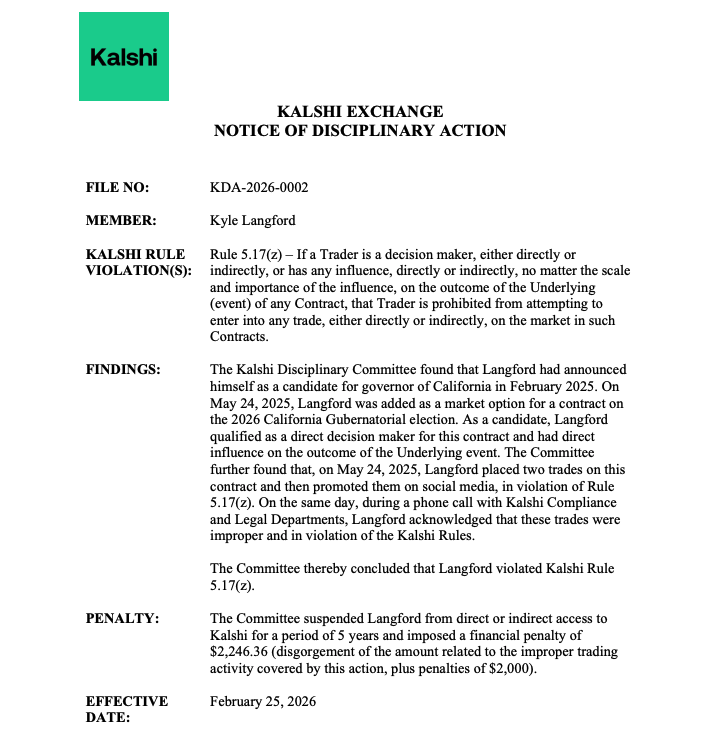
The first case involved a political candidate, Kyle Langford of California, who traded roughly $200 on his own California gubernatorial candidacy and later posted about it on social media.
Kalshi’s surveillance department identified the video in May, froze the account immediately, and opened an investigation. According to Kalshi, the candidate acknowledged the conduct violated exchange rules prohibiting trading in contracts where a participant has direct or indirect influence over the outcome.
Penalty:
- Five-year suspension from exchange access
- Financial penalty equal to 10 times the initial trade size
- Disgorgement of profits
Kalshi noted the individual has since ended his gubernatorial bid and announced a congressional run.
The CFTC said the conduct potentially violated Section 6(c)(1) of the Commodity Exchange Act and Regulation 180.1, which prohibit manipulative or fraudulent schemes.
YouTube Editor Trading on Advance Knowledge
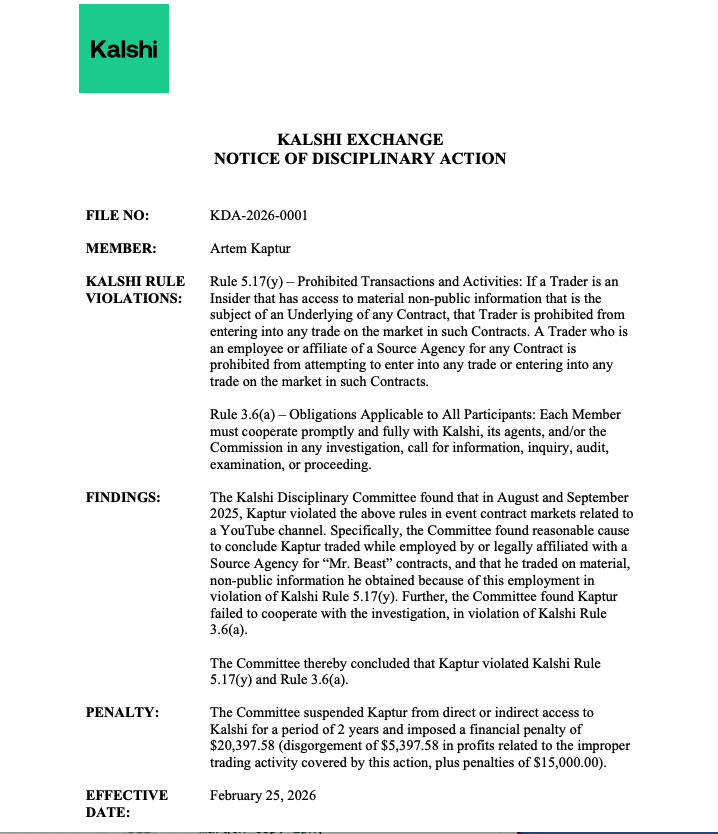
The second case involved approximately $4,000 in trades on markets tied to the content of YouTube streamer Artem Kaptur.
Kalshi’s systems flagged the account after detecting near-perfect trading success on low-probability contracts — a statistical anomaly. At the same time, users reviewing public trading data submitted tips about unusual activity.
The investigation determined the trader was employed as an editor for the streamer and likely had advance knowledge of video content prior to publication — material non-public information.
Penalty:
- Two-year suspension
- Financial penalty equal to five times the initial trade size
- Disgorgement of profits
Kalshi reported that neither trader withdrew profits and that accounts were frozen promptly after detection.
The CFTC characterized the conduct as potential misappropriation of confidential information — commonly referred to as insider trading.
Kalshi: 'We Ban Insider Trading'
In releasing details of the cases, Kalshi emphasized its compliance framework.
“As a regulated exchange, we ban insider trading,” the company stated.
The exchange reported both matters to the CFTC. Kalshiwill donate collected fines to a nonprofit providing consumer education on derivatives markets.
Kalshi also announced the formation of an independent Surveillance Audit Committee, which will issue quarterly public reports detailing flagged trades, open and closed investigations, and cases referred to regulators.
CEO Tarek Mansour has repeatedly defended the exchange’s surveillance systems. This comes amid ongoing state-level litigation. One consistent claim is that that prediction markets operate with transparent audit trails and strict compliance standards similar to traditional futures exchanges.
“No system is perfect. No financial exchange is immune from bad actors,” the company said in its enforcement release. “We’re committed to deterring and finding the bad actors, manipulators, and those who willingly cheat.”
Federal Authority Reaffirmed
While Kalshi handled the investigations internally, the CFTC made clear it retains full enforcement authority over trading conduct on any DCM.
The advisory referenced insider trading, wash trading, disruptive trading, fraud and manipulation — all prohibited under federal commodities law.
The announcement arrives amid intensifying jurisdictional disputes between federal regulators and multiple states. Those states include Nevada, Massachusetts, Maryland and New Jersey. They have challenged sports-event contracts offered by prediction markets.
As previously reported, CFTC Chairman Michael Selig has taken a more assertive public stance defending federal jurisdiction. In a recent Wall Street Journal opinion column, he warned that the agency “will no longer sit idly by” while states attempt to undermine its oversight of event contracts.
The insider-trading advisory reinforces that position: prediction markets are derivatives exchanges subject to federal anti-manipulation rules. That includes standards long applied in futures and commodities markets.
What It Means For Sports Contracts
For traders, the message is clear: political, media and sports-event contracts carry the same insider-trading risks and enforcement standards as traditional derivatives.
For state regulators and sportsbooks engaged in ongoing legal battles over sports-event contracts, the advisory underscores the CFTC’s federal authority. And that authority — not state gaming regulation — governs these exchanges.
For the broader prediction-market industry, the public disclosure of enforcement cases signals an effort to demonstrate transparency as the sector continues to expand into sports.
The CFTC’s warning makes one thing unmistakable: the rules of market integrity apply. At least on paper. This holds true regardless of whether the contract is tied to oil futures, elections or the Super Bowl.
 Top Online Casinos October 2026: Top 10 Real Money Casinos in the US
  $5 Dollar Deposit Casinos Launched in Alberta October 2026
  Rebet Referral Code BOOKIES: Matched Bonus Up to $100 in Rebet Cash
  Top 5 Betting Apps Right Now October 2026
  Fliff Promo Code BOOKIES: Get up to $250 in Free Play
  Alberta Stanley Cup Betting: How to Bet on Edmonton Oilers and Calgary Flames
Comments